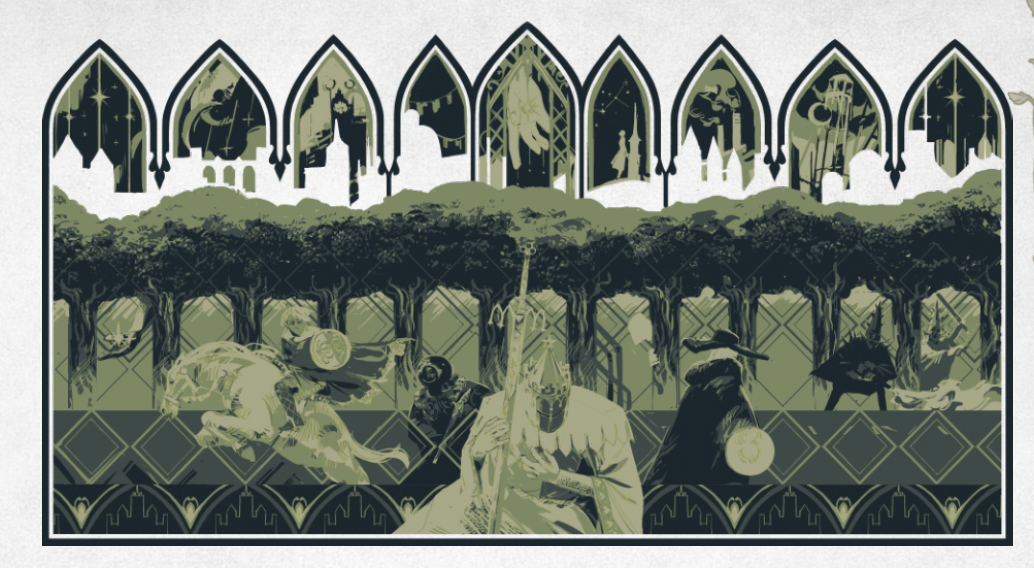
Tag: mythic bastionland

  • The Mythic Bastionland GM Oaths

    There’s been a little cottage industry of advice for Mythic Bastionland. I’m not proud enough to resist. Pride was always my dump sin.

    You can understand why the industry. Some games need cheat sheets. With Mythic Bastionland, there’s an unserved market for someone to expand the rules from their haiku-like density into something more bloated, spending a page explaining on what Mythic Bastionland does in a sentence.

    So: what should a Mythic Bastionland GM do?

    I think it’s exactly the same as the players. You follow the oaths.

    • Seek the Myths
    • Honour the Seers
    • Protect the Realm

    It’s just that they have a different meaning for you, the GM.

    The Sprite illustration

    Here’s the short form. I’ll expand afterwards

    Protect The Realm

    The realm is the heart the game and, first and foremost, you must protect its integrity. Know the big picture to start with, and increasingly fill in its details. Once conceived, it exists. The primacy of the players’ actions is reliant on having a real environment to interact with. If a world changing event happens, you need a world to have been changed.

    Honour The Seers

    Your seers are the dice. Your seers are the spark tables. Your seers are the enigmatic sentences of the game. Do not consult them idly. When you consult them, honour the results. What the seers have told you is as real as anything else.

    Seek the Myths

    You have to seek the myths, because they are from outside the realm. The Myths are written in short, evocative statements. It’s only through interpretation (honour the seers) and contextualisation (protect the realm) they can enter play in a meaningful way. The world exists, and then the Myths arrive to distort that.

    Protect The Realm

    This comes first, because it literally comes first – both in the manual and in your planning.

    In a previous career, I was at a games conference in Australia. An academic was presenting their research, based around recording games and breaking down what actually happened. He asked what we thought we did in Mario 64. The room gives the obvious answers, in terms of all the colour and character. But no. 85% of Mario 64 is moving a figure on a 2D plane. Everything else is an aberration to that norm. It’s also why the simple basics of Mario’s movements are so polished and satisfying – because if they sucked, it would slowly erode your joy.

    When looking at Mythic Bastionland, it’s easy to over-stress the myths. They’re the vast majority of the book, after all. But no – the actual core of the game is those first 16 pages of rules. These are the equivalent of Mario moving on a 2D plane, and what everything else emerges from.

    Don’t let the short form confuse you. You’ll find everything you need to run a quasi-medieval kingdom. Famines? Got you. Sieges? Got you. Taxes? Yup. What an average peasant in a small town knows about the existence of Myths? Oh yeah. If you are trying to simulate a realm, it will support you. Trust the core game. This is a key part of Protecting the Realm.

    The second key part is to have a Realm to protect in the first place. Yet again, follow the instructions – generate a map, either manually or using one of the online generators. I recommend this one, which lets you edit and tweak as you progress.

    Then, at the end of the Create The Realm page, there’s a wonderful bit of Mythic Bastionland’s laconic nature.

    ADDING DETAILS
    Spark Tables (p22) can add detail to significant locations and people in the Realm.

    There’s whole universes in that sentence, and is where the OSR-classic technique of Blorb is turned to more characterful focus than its traditional worries of how many skeletons are in a room. Turn to the spark tables to create the rulers of this realm… and then honour their reality, and protect it.

    They’re not Spark Tables to you, however. They’re Seers.

    Honour The Seers

    Mythic Bastionland is a game where spend your time looking into the guts of a butchered animal, trying to read the future in the turns of entrails. I wonder what could this gloopy whirl of intestine mean?

    Then you see, and it is true. It is true, because you are honouring the scene. And once it has been decided it is true, it is part of the realm, and must be protected.

    (In play, I keep the generators to hand. I mostly use the online generators, which lets me generate what I need at a glance – this one and this one are in a tab at all times.)

    When I created my Realm, I rolled up the Ruler in the Seat of Power. The Fox Knight. I roll a prompt for History. “Nomadic Injury”. This makes me think that he is not originally from this realm… but also perhaps the injury was caused by a nomadic people. As the meme says, why not both? He reclaimed this land from invaders who had previously held it, but has been injured ever since, in a Fisher King-like mode.

    But then I remember he’s the Fox Knight, whose special ability is to create illusions.

    A plot of an old novel book returns to me – a king faking illness to try and lure his enemies out. I lift it. I roll his name. “Foxter.” How can I ignore the Seers when they’re all but screaming at me?

    That’s the background of this kingdom – a king who is trying to create a trap. This is our reality, and I will not back down from it. It is as real as the dice in my hands.

    I turn to the other three holdings. What do we have here? I roll two knights, which instantly feel like his children. One has “Outcast Romance” and “Resentful Guardian” and is the Meteor Knight. I realise that the flip of having a father pretending to be weak is that everyone else has to take up the work. I see this knight is in charge of the bustling town by the local lake, and soon I have the image of Peryna, the knight who wanted to adventure, but has instead basically ran the economics of the kingdom… and was also driven away from her father when he refused to accept her love match.

    She’s joined by her brother, Endry, whose prompts I have absolutely misplaced, but was in the “Sharp Fortress” to the east, which make me realise the invasion would traditionally come from that direction. He’s the one who’s handled the military situation.

    Finally, we have Gedric, a “Deceitful Healer” with “Academic Migration” and “Tumultuous Enemy” plus in charge of a “Soft Citadel”. That comes together to make an experimental but evil academic who came along with the Fox Knight, but is increasingly frustrated by not being allowed to do what he wishes… and has plans to betray the realm. The “Soft Citadel” is metaphorical – it’s the soft underbelly of the kingdom.

    So that’s the political situation. I realise the inciting incident of the campaign is that the Knights arrive here, having heard a call for Knights to help a realm in peril. They think it’s from the ruler – when in fact, it’s secretly from the desperate son in the under-powered Sharp Citadel.

    And that’s where I start the game. There’s a few two-word prompts for some of the landmarks, but mostly I’m not interpreting them yet. I don’t need to know them yet – just the context of what the players are near. This is the tinderbox that the knights are riding into.

    So, it’s all set up to be a realistic game of politics, generational betrayal and warfare.

    Seek The Myths

    Now we set fire to that.

    Of course, the players will do that by their explicit actions, as they interact with all the cast and do all the things players do. It’s a setting, not a plot. Would the players obey the King? Join the enemies? Keep the secrets? Take over themselves? Ignore it all, and let it play out, and do their own thing? Their call.

    However, they will also do that solely by the mechanics, as they seek the myths.

    You don’t need to prep Myths due to all the work you’ve done by following the previous two oaths. You know the Realm. You know where they are. You know what else is going on. You know who rules the nearest settlement. And if you don’t, you consult the Seers some more, until you do.

    As such, you can then integrate the myth events with the fiction of the world, and what else is happening. The Goblin is stealing young people? And you’re by the Sharp Citadel. When you know the Sharp Citadel is desperate, you know that will include their young soldiers – leading to our knights meeting their first Squire. At the absolute least, you know who will be upset that a Hydra is rampaging around eating people.

    In short, when you have sought the myth, you then protect the reality of the realm (by integrating the myth with what you already know) and then consult the seers (to interpret what the details of the myth means in the context).

    To choose one example from the campaign: our own Hydra haunted our realm for 50 years. This meant it first met the Knights when our band were teenagers, and was defeated when they were well into their dotage. They knew the Hydra could only be endured… but wanted to find something else to end its blight. They turn to the Seers in the game. I turn to my Seers, in this case the Myth itself.

    What is the Hydra? All the Hydra says is “The Hydra, punishment for past sins.”

    I consult the Seers of that sentence. What is the sin that needs to be punished? I protect the realm.

    The sin that has shaped the whole game was the Fox Knight lying to his children – and the whole realm – for his own strategic decisions.

    And we went from there. We climaxed in a battle in a burning forest, where they try to forgive this embodiment of sin to death.

    PUTTING IT TOGETHER

    Soon enough the Oaths are all talking to each other. You sometimes realise you want to do more – and you can. Your desire is another Seer to honour. The Goblin’s myth says he has a lair – so I turn to the Site rules, to generate it (as a generator, it’s also a kind of Seer to be honoured). It’s not even always about the Myths. Reading the Entombed Seer I am inspired by a few lines, and feel I want a site from it. I honour the Seer by creating it, I protect the Realm by placing it in the world and (together) we Seek the Myth when a petrified (NPC) knight begs to become entombed in hope the Hydra can’t find her.

    Our game was full of this stuff – elements that were randomly inspired, treated as real and then warped by myth.

    I’ll end with an extended bit from where I felt the game was singing, the best example of the realism of a realm within the grandeur of myth.

    I was going to write this going “Protect the Realm”, “Honour the Seers” and “Seek the Myths” in brackets after each incident, but I’ll spare you, as frankly, it’d be unreadable. If you want an exercise, re-read it and do it yourself.

    It was when the Fox Knight’s plan was put into action. The Invasion had finally happened. The Knights’ mission was for them to lead an army to outflank the invaders, and take the traitorous Soft Citadel behind them. Holding that cuts off their supply lines, so leading to a final battle at favourable terms.

    So far, so War of the Roses drama. This would have been great on its own, and the game would have handled it perfectly. However, this is Mythic Bastionland. The Myths have other ideas.

    The Knights leading their warbands up the western flank starts setting off Myths. Namely, the Mist. The mists that have filled the lands for fifteen years start to thicken, and soon the travellers can barely see… and monstrous figures begin killing isolated soldiers. No-one is getting any sleep, and their abilities crater. Soon, they are reduced to walking in a chain, with no visibility beyond arms’ reach.

    And then the Wheel of Time kicks in, and spring turns to winter. Immediately, the players understand the seriousness of the situation – if they camp outside, they’re going to start to starve to death, and will soon lack the strength to fight. They have to work out a way to get inside the castle, immediately. At which point, the next Mist myth omen kicks in – which is that of troops from a nearby holding spotting them and opening fire, thinking they’re the monsters. Of course, that’s the holding they’re about to try and get into. Our desperate Knights rush them, defeat them and then barter with the leader to turn them, try and sneak inside the castle and take it, leading to a solitary duel between a knight and the murderous academic.

    Meanwhile, however, I’ve been protecting the realm in a key way – winter has appeared for everyone. The knights know they’re in trouble? So does the invading army. What do they do? They’ll head back to the citadel which they still think is secure, and stay the winter. Do they march together, or do they separate units? I’ve generated their leader. I know him. What’s he thinking? I use the rules for movement to see how long it takes, and whether they get lost or not. I also keep track of how many nights their units have been outside in winter, and track how it hits their vitality.

    So a few days later, the invading army arrives. It’s enormous, so looks like bad news. However, I know they are paper tigers – they are on their last legs, and most the units will scatter if attacked at all. What does this army do? Well, they try and bluff, clearly. Their guide is sent forth to try and talk their way in… and she’s the woman who the knights let run off to the east fifteen years earlier, now with her ancestral enemies, because a girl has to eat, right?

    Can she talk them into letting them in? What does she do when she fails, knowing that she’s going to get her throat slit if she can’t? Well, she’s going to desperately try and switch sides again, because that’s who she is.

    And what would the players do to that?

    I had no idea. Hell, I was always aware there was a fair chance of the Hydra just turning up throughout all this and eating an army.

    This is one reason why I’ve found Mythic Bastionland so wonderful to run. It’s a game which generates such a rich space of narrative and possibility, encouraging you to think of a fiction from so many angles, and so richly. For a game which is clearly at heart from the OSR tradition, it creates a narrative that is ripe with character and life.

    I don’t mean this is a story game – I mean narrative as a series of events. Story is what is created retroactively, from looking at those events and taking joy in them. And, at its best, Mythic Bastionland creates History – a saga of a realm and its people, their struggles, their failures, and how they survive and are transformed by the forces of Myth. And that emerges if you just do what the game asks you.

    Protect the Realm. Honor The Seers. Seek The Myths.

    Mythic Bastionland is on sale now.

  • THREEDOM: MYTHIC BASTIONLAND

    Mythic Bastionland, the latest game in Chris McDowell’s Bastionland series, was one of the best-smelling books we had ever encountered when it arrived last year. But some people suggested it mattered how it played, and that was something we could not discern from residual ink-scents alone. To find out, we rolled up our chainmail sleeves, watched John Boorman’s 1981 knight-based masterpiece, Excalibur, and then dove headlong into the lake where there was probably a sword or, if not, some sort of wretched wyrm of myth with which we might wrestle in the dark and wet.

    (more…)
  • Kiery G on Mythy-B* on The Smiling Fox

    We wrapped our Mythic Bastionland campaign last night. We’ll be doing a Threedom soon enough, I’m sure, but if you want an advance taste, I was on the Smiling Fox, the premier** Mythic Bastionland podcast, last week talking about the game generally and my game specifically. It’s basically me and age jumps, sitting in a tree, k-i-s-s-i-n-g mortality in a sexy way.

    You can listen here – the Smiling Fox was a big part of my process for running Mythic Bastionland, so was really lovely to come in and guest as I was wrapping our game.

    * Joke Stolen From Chris McDowall
    ** Only.

  • Open Hearth, Open Mouth

    Jim and I were having a chat (via text, in one of these new fangled AIM-replacement bits of software). Should we link to places where we’ve talked about RPG stuff here?

    Yes. We decided the answer is Yes.

    Open Hearth gaming community has a bunch of podcasts – one of which is the community podcast where they invite a couple of folks on to talk about what they’ve been playing, on and off the Hearth.

    The last one had Lowell Francis chatting to Cat Rambo and myself about all things new. For me, new was Mythic Bastionland.

    Listen, if you want a taste of forthcoming Hot Takes on the micro-pendragon we like to call Mythy B and if you’ve never had the “Wait – this is what he sounds like? He sounds like if you pumped Noddy Holder full of amphetamine.”

    Listen here.