
Kieron: Chef.
Jim: Yes, Chef.
Kieron: Let’s hit the basics: Tim “Blades ’68/Deathmatch Island” Denee has clearly been watching too much of pressure cooker show about the pressure of cooking, The Bear. He takes the Paragon system (Agon/Deathmatch Island) and makes Every Second Counts, which is basically The Bear, the TTRPG. We have a skip week in our regular game, so I hustle to run a one-off, a level of panic which actually is thematically appropriate, at least. Every second does count. Probably best to start with our The Bear priors, right?
Jim: So I stopped at some point in Season 3? Early on, I think. And I understand this is a fairly widespread experience. I have yet to check out the seasons which apparently return it to its form. However, the first two seasons were perhaps enough. I watched them both while convalescing from illness and they have written themselves into my soul, even though I have studiously avoided personally knowing anything about kitchens or hospitality for most of my life. My wife works these things, and the stories are harrowing. The TV show is virtuoso in those early seasons and I can understand completely why a TTRPG designer would pick up the baton of “fraught, emotionally-complex situation where problems keep piling up.”
Kieron: Loved the first season, thought the second was top-5 television of the last decade, felt the third was meandering and self-indulgent (which is not a critique my self-indulgent ass often gives), and was enjoying the fourth until I hit the hour-long episode. We didn’t have the emotional resilence or time to watch in one go – every second counts – and got distracted. Prompted by the 5th season, we’re back to trying to watch it now, except my daughter presently gets to sleep late enough to mean any TV watching over 30 minutes is impossible, so we’re stuck at that 1 hour episode still. But the Bear’s back on my mind, so Denee releasing this was well timed. So… what did you make of it?
Jim: There was a sudden access to the cleverness we detected in playing Agon, and I think Denee has also felt this. It’s a game engine which allows certain stuff. Harper himself picking it to make an LA street racing game is sort of revealing. For a narrative experience that has elements of both co-operation and competition, it’s a toolkit that makes an incredible amount of sense. You yourself have some intimate familiarity with this in terms of the Paragon rules, but more widely we both do: adapting game systems because they are complementary to the setting you want to explore is now not simply a possible or valid way of making TTRPGs, it might be an ideal one. But that’s an assertion that probably requires a bigger canvas… So seeing this come up as a kitchen stories game made a perfect sort of sense. And it was, as we shall get into, particularly well poised for that use. And this was served as a one-shot– what did you make of it in terms of being able to run for that single evening’s play?
Kieron: While Denee has done a lot here to make it specific, there is one single choice which makes it especially ideal for a one-shot: It runs off a timer. After character generation, all play is either Before Service (all the stuff in the day, spiralling out) or Service (Seat those people, serve those people, try and blow their minds). Each has a strict, real-world one-hour timer, max. If you hit the one hour, it ends. In other words, this is a game that’s designed to absolutely capture the pressure of the show – while also meaning that the one-shot will fit in an evening, and even if you do run out of time, that’s also the game. Chargen (and Restaurantgen), Before Service, Service, Epilogues? That’s easily within three hours.
You even put the timer in the middle of the screen, so everyone knows the time is ticking away. That’s pure The Bear.
And while it’s not entirely a paper-tiger, an hour works. I had time to explain the rules in Before Service, have a bunch of character work, and three challenges, and the timer ticking down was exciting rather than a problem. For Service, we actually ran short, with the five challenges (would have been six, but you decided to ignore the fact upstairs was flooding). Did you feel the pressure? Because the bathroom bogs certainly did.
Jim: Pressure mechanics, even ones as trivial as us getting the GM to say “The Hogmen are coming!” in Hogmen, really do add something and that was the case here. However, we were actually fairly calm about the impending time-pressure, and I can imagine some groups might find it particularly provocative or stressful. I think the group we had assembled were actually rather sanguine. My cucumber-cool final moves as the clock was counting down was hugely satisfying! And I was delighted by how it framed a one-shot, actually. I tend to work hard to hit our regular RPG night deadlines, while also ignoring the clock, so having it RIGHT THERE was a frame-changer for me that actually made the whole thing zip by.
Kieron: Though there is another reason that it runs quicker – this strims down Paragon. Players just have fewer assets available, so dice pools are more easily constructed. While not having bonds with fellow chefs to start with is one big change, the main one for Paragon-heads is swapping Faction Bonds for Bonds with the other characters in the restaurant, and rather than adding a D4, you add a +3 to the dice pool. It’s a nice mechanic in Paragon, but there is a cognitive load to adding a dice which works in a different way, and a straight bonus lets it run quicker and grasped more easily.
In passing, the core of the game is still Paragon. In the roleplay, there are challenges to deal with: GM and the Chefs who want a shot at these assemble and roll a dice pool. Players narrate the fiction in the ascending order – and if GM is highest, the Chefs fail the challenge, and have to narrate that. In that space, they all have complete narrative authority. It’s different to a traditional TTRPG in a few ways (not least, you don’t say what you’re trying to do before you do it) but it works well, and better the more players understand the power they have. Anything stick out especially interesting in the Paragon mechanics to you? The biggest changes are what it does with Camaraderie and the players’ baggage…
Jim: So I should talk baggage because this is the part that is an obvious mechanical connection to the motifs of The Beat, and hell, almost all kitchen drama since, well, the documentary hype of Kitchen Confidential? (God bless Bourdain.) Baggage is a big dice, I believe starting on a d8. I soon had an advance to push it to a d12, because as an expert chef I was already starting the game on max stress and on the “Burnout” track of advancements. This meant that I was bringing my baggage (a fear of failure, and living in the past) to my narrative descriptions of what was happening in the restaurant, which meant that I was handing dice to you, the GM, to up the stakes of later chaos. Look guys, this is a reason why Paragon is so good: an engine for escalating stakes and escalating drama, in a dice pool. That’s where juice comes from. Mortgaging the group’s success by accidentally having the baggage be the highest dice, and therefore the centre of the narrative, and therefore upping the stakes (steaks) in the later rounds, therefore causing us to need to burn even more resources, well, that’s just a delicious meal.
Kieron: Baggage replaces the “name” in the standard mechanic, so it’s the core dice you always get. That you can advance it to take it higher or lower says a lot about how the game operates. Are you leaning into or away from the demons? What haunts me makes me great but also ruins my life. What now? Theme.
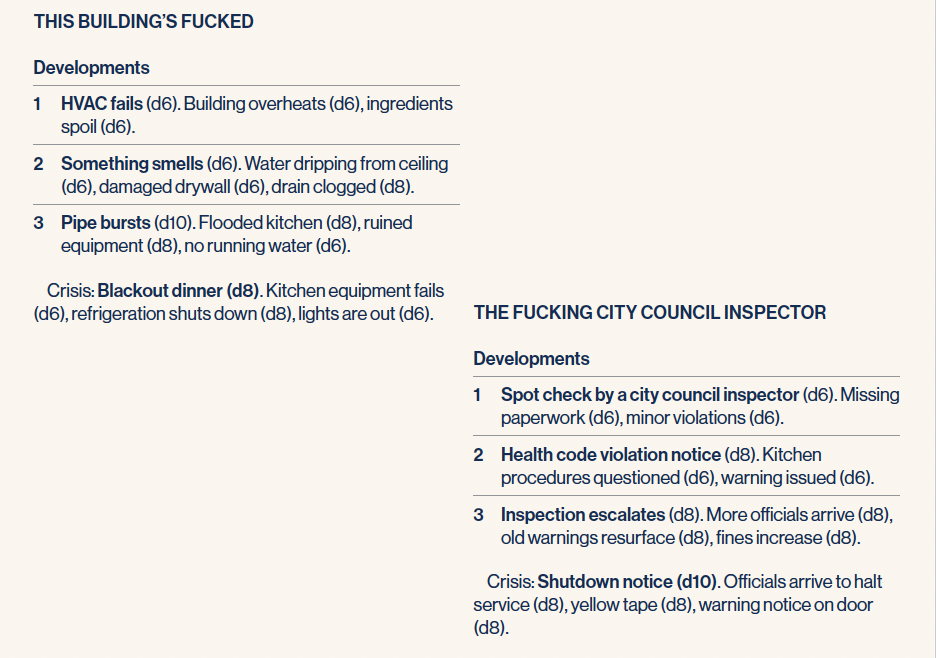
That said, I’m not quite sure it has the teeth it could, as the game is significantly more generous with higher dice than standard paragon. As standard, Chef’s highest starting domain is a D10 – so higher than standard Paragon. You can burn stress to add it to a challenge – and likely will do so often. There’s other D8s. The baggage being highest is a sometimes rather than an often problem… also, if that happens, and the GM gets to use the baggage dice in a later challenge, the impact is less for the GM than the Chefs due to how the dice work (GM is highest dice + 4-6, depending, players are two highest dice – so their big dice have more effect on their total, if they roll well – and with multiple players, there’s more chances for that). Equally, with the high-dice players, most of the GM’s dice pools seem low on most challenges. Did players fail? Yes, but not often enough.
Jim: One thing I was aware of was that we were doing pretty well overall, and I felt like my gigantic final roll (expert chef Harrington Spicer was BEST! But this is a co-operative game…) was perhaps unearned in a situation where we should have been struggling to keep our heads above water?

Kieron: There’s also a little tension between the power the Paragon system gives to narrate any outcome, and the guide that any single challenge likely won’t solve any given problem (or “Clusterfuck” as the gloriously on-point rule calls them). None of these are major problems, especially for a hack like this. On a one-off, I don’t think any player would have even noticed. This is just me being Paragon-brained right now.
Really, it’s great to see Denee play with different ways of doing things. Like, rather than Paragon-standard glory (Doing well in challenges increases your name dice) players gain camaraderie (doing a challenge with a peer increasing both your score, which increases your teamwork dice). You add the teamwork dice by spending bonds. You earn bonds by having screaming rows with your fellow chefs rather than doing challenges. It’s a game which moves away from “team on a shared task, competing to be number one” to “a deeply dysfunctional team who are their own worst enemies and also their own saviours”.
Basically, it’s clearly a love letter to how Tim sees the Bear. It was great to spend an evening and just get your Bear on.
It also includes some entertaining Fantasy Bullshit, Blades ’68 Bullshit and Cyberpunk Bullshit, for those who cannot step to the table without having an orc turn up.
Jim: As a side note, I think a setting like this (it all happens in the restaurant, because it has to) is a powerful tool for TTRPG play. It is the dungeon of narrative.
Kieron: Yeah – honestly, a real world setting sings here. Workplace drama is both a real world thing (we who work have workplace drama) and a genre (we love drama in the workplace). Coming off the back of the Pitt, I’ve been chewing over the efficiency of that as a storytelling engine. Denee has looked at the Bear, and for the love of the game, made a lovely game. Paragon’s more structured approach to a TTRPG works well – the ritual of the workday – but despite the timer, it leaves a lot of space for just generative play, with inventing a world of quirky, driven, messed-up weirdos, and then playing them. I haven’t mentioned the random-NPC-staff generation tables, which really worked and made people I loved playing. Probably the best thing I can say is that since playing, we finally went back to that hour long episode, and watched it. And watching the extended Bear clan at a wedding, I felt… yeah, in an evening, with Denee’s rules and our minds, we at least a cousin of that, cuz.
Hands!
Jim: Hands!
Every Second Counts is available on pay what you want from Denee’s Itch page.

Lost in the hills of Somerset, this Rossignol searches for meaning among the clattering of small plastic bones.