It is this organ’s firm and unyielding belief that one cannot review an RPG from simply reading it. You can review a manual, certainly, but you’re not reviewing the game itself in any meaningful way. You need to play it to do that, obviously.
However you can skim and see what pops out. So this is Not A Review. It is The Skim.
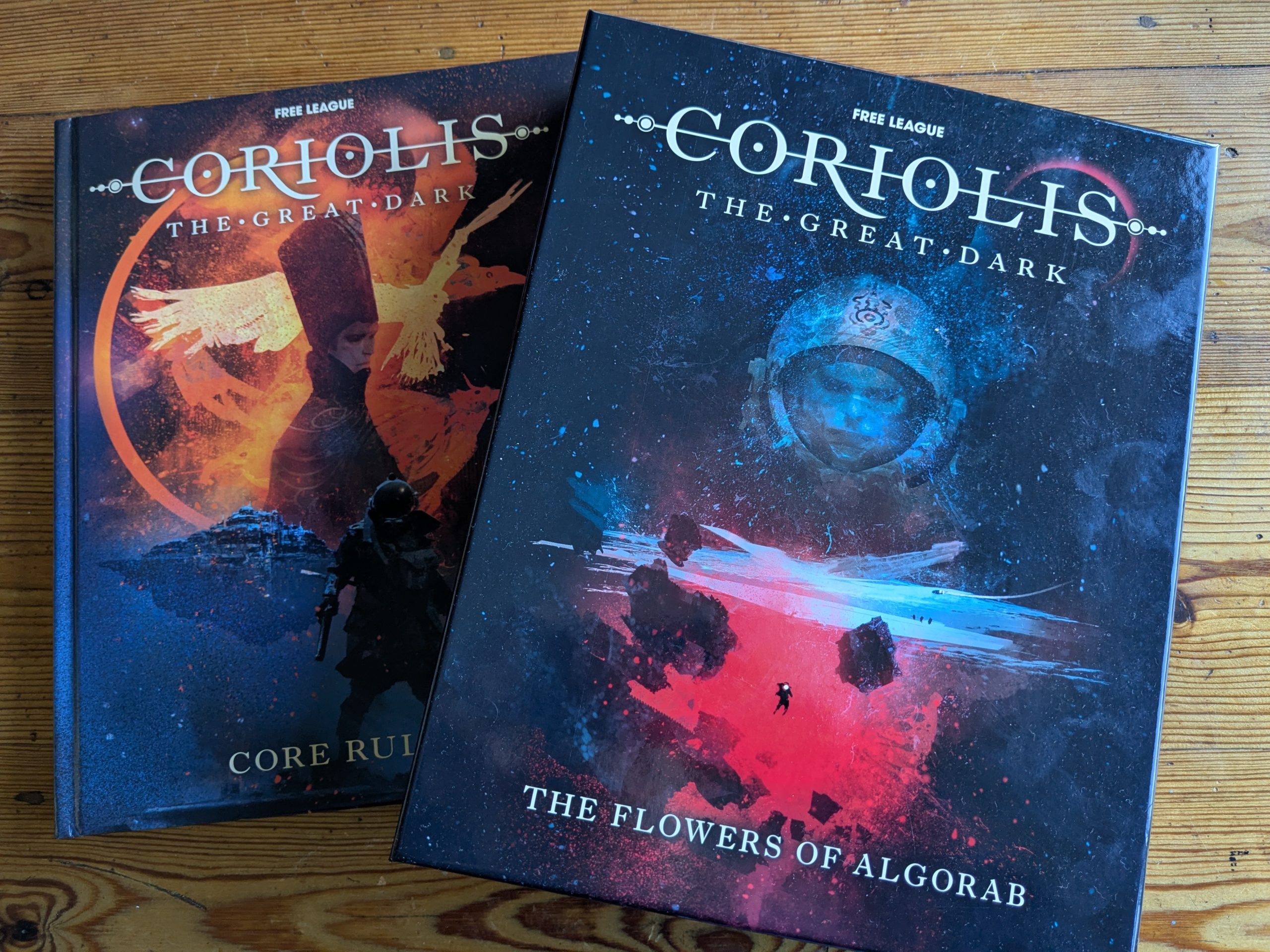
Faithful readers may recall that I have been casting about for a sci-fi spaceship game to play with one of my regular groups. One game that came under my lens during this scrutiny was last year’s Coriolis: The Great Dark. This was not so much because it was a good candidate for a spaceship game — it’s not really about that, despite containing many cool spaceships, living and dead, as we shall see — but rather because I got excited when the Kickstarter came around and then ended up in possession of a large hardback book, a box set campaign, and some dice with little symbols on where the 6 should be. Such is the TTRPG life. Anyway, I had a good look and decided Coriolis didn’t fit the bill for our spaceship requirement. But it was still pretty cool. Hmm!
Worse, this week the guys over at Free League revealed that there’s going to be another The Great Dark book, an adventure compilation with bonus spaceship description, called The Fractured Library. I feel obliged to buy it, even though this is not a game I am necessarily going to run. So could this game end up being my Significant Game I Want To Run But Perpetually Haven’t? That RPG line that I own all the books for, but forlornly accept I won’t actually get to the table? It could be. It might be.
Just as an aside, Kieron’s Significant Game I Want To Run But Perpetually Haven’t, I understand, is The One Ring. He has all the books! He just got another one in the post. He was pretty excited about it.

Anyway, when I was planning games for this year Coriolis: The Great Dark was among the candidates for those I might get to the table, to the point where I began testing things and planning. But in the end it wasn’t the one the players really bought into, so I ran The One Ring instead.
With the group that Kieron isn’t part of.
Yeah.
So while we’re out here wielding ironies like evil daggers from Mordor, I should note that the irony of wanting spaceships and ending up with Tolkien is almost as sharp as that of wanting to run a Free League game and ending up running one that doesn’t use a variant of the Year Zero system. Which I also really do want to run! I am so sorry, me! I apologise to past me and my future self, and you, dear reader, for this awful digression.
What I was actually going to do was skim Coriolis: The Great Dark and see what popped out. Let’s do that bit now.
Year Zero-powered Coriolis: The Great Dark is a sequel to Free League’s original science fiction game, Coriolis: The Third Horizon, and aside from having a slightly more evocative second clause in the title, it had a clearer sort of pitch: you are the children of intragalactic space refugees living in a dwindling asteroid city and have to do emergency space archaeology to survive. This might be understood, more prosaically, as it being a dungeon delver. Of course The Great Dark does dungeon delving with retro-futuristic diving suits and a technomagic bird instead of wizards and a ten foot pole, so that’s why we’re here. All of which is not to say that The Great Dark isn’t intending to do the all-encompassing campaign thing of a big box trad sci-fi game, it totally is — it has rules for vehicles, a giant space city with its own ludicrous map and list of factions as long as an alien’s leg, and even cursory rules for strange space artifacts and travel between the stars — but the procedure it hangs its entire space hat on is for a team of space characters using their space abilities and space equipment to explore space dungeons. And that’s fine by me.
The vibe the Coriolis books have pitched for is important. Coriolis taps into a very potent “1970s sci-fi cover art” aesthetic that was rarely lived up to by the 1970s sci-fi novels they actually graced, and has here and there been transmuted by modern sensibilities into a fresher sort of star fantasy. Coriolis benefits enormously from the Tumblr-generation’s desire for esoteric-but-palatable sci-fi to tap into this there are strains of the classics alongside stuff that you might have glimpsed in Metabarons or Moebius, mixed with references to 19th century exploration, and so it never feels staid or rehashed. It needs to be, I think, a game that lives up to that specific mood and tone, and for the most part the books do this.
Coriolis does some bold worldbuilding. The core book is packed with more talking to weird guys in a mask than most people could ever care about, and the campaign box goes much further still. In fact, my first thought after reading it all was about the amount of work necessary to abbreviate the official campaign to the length of game my groups were likely to accept. We’re all enthusiasts for new stuff, and so Very Long Campaigns are generally not on the table, so to speak. Keeping it reasonable would be the second task. After getting people on board in the first place. But let’s come back to that key point in a moment.
Corio-listen to this: I rather bounced off the original book, and didn’t run it, but The Great Dark’s urgent space archaeology core has a rather more, I don’t know, indie sort of laser focus to it. Less generalised messing about in space, and more tight procedure. It’s got a beating systemic heart. That really appeals. It’s one of the key reasons I own it all today. However, and I meant this with respect, although it’s not going to read that way, the original book’s text, while fine and serviceable, had an air of being rushed which, I am sad to say, does persist with The Great Dark.
It pains me to say it, but the quality of the language in these books does not meet the scale of the ambition, invention, production quality, or art. The package delivers all of those things with conspicuous energy. It’s brimming with big ideas and amazing scenes. Lead artist Martin Grip’s virtuoso splattery impressionism, which first emptied my wallet for the Symbaroum books, has once again proven that it can carry an entire RPG series, although there are other artists involved here who really do astonishing work too. These books do have the usual Free League sense of lavishness. Buuut… The Great Dark doesn’t always do itself justice when I am sat in my armchair with the reading light on. There’s some bland and unadventurous writing, some of it is waffle. The whole thing needs a stern editing. And do not think that’s a general dig at Free League: I’ve read Vaesen, Tales from the Loop, and The One Ring and enjoyed the writing in all of them. But here the art and design is doing the heavy-lifting.
But let us continue to skim. We soon discover why it got crossed off the spaceship game list. This is a game with spaceships, but is not about them. There are definitely spaceships! And it explicitly pitches the idea of space as the sea, and its vessels as the great sailing ships of yore. There’s rules for them and pictures of them and tables for doing stuff with them as they fly about. There are fricken’ star charts with currents and things, which I don’t think is a thing in space, except it is here.


These spaceship diagrams also add to the appeal.
So the ‘greatships’ are, by themselves, pretty great, and hugely exciting prospects for a dork like me. There’s even additional hurdles for travelling between the ship and your space dungeon for your bout of archaeology/theft. The interstitial journey is a distinct (if not explicit) phase containing dropships and surface rovers.

But The Great Dark is not about the crew of a spaceship going down to a planet in the sense that a Trek TV show has an away team, or Firefly had that wagon thing, or my fantasy of a game about basically being the crew of the Millennium Falcon back when they were just doing smuggling jobs would be if they somehow had a speeder. No, it’s not even about being a crew on a planet in the sense that the crew of the Nostromo is in Alien, when they go check out the alien ship, although it’s closest to that.
What it’s about are these cool spelunking diagrams.

The action is the delving. And for those what is important are these “scan” maps. One of your characters does a scan and things are detected and stuff. This matters to how well the adventure is going to go.
I suspect these actual maps will be fantastic to use whether you run this at the table or remotely, because they quantify the experience while also adding a bit of mystery. What’s down there? What if we have to come back? This is a procedure-driven explore ’em up. It’s a science fiction dungeon-delver, and a sexy one, if extremely trad RPG procedure can be sexy. (It can!) Taking damage from a reality-warping space plague called The Blight, and using the technomagical bird android thing called a Garuda to counter it, reads like catnip to me.
It has a chapter called THE BIRD & ITS POWERS, for God’s sake.

I love the remote-controlled ‘kites’, the space heirlooms brought from far reaches of the galaxy, the “deep sea” space suits, the idea of this frozen void populated by desperate factions who are all basically depending on each other.

These cool character designs don’t hurt either. ‘Odd Jobber’ might be the best character class in a game like this.
It all makes me think about how Symbaroum was about this big old forest full of ruins and didn’t have a laser-focus on surviving the big old forest full of ruins. They haven’t made that mistake here.
However, it was turning to read the campaign box, The Flowers Of Algorab, that really brought things into skimmed focus.

It’s one thing to read through a book of core rules and have your own vision of how the thing is going to work, and quite another to read a book that is (presumably!) how the game is intended to be run. As I said earlier, there’s a lot of material here, some of it is space dungeons, but there’s also a great deal of politics, factional wrangling, exploration and travel, but also the campaign has an extraordinary denouement which, how do I say this without spoilers, well, it really changes things for the setting in a way that surprised me. Did they really do that irreversible thing? I guess so! It’s all really ambitious stuff. I should get someone to play it!
And so this brings me to getting my players on board for this. The second of the two campaign books, which contains a tonne of stuff about a spaceship, but also about the arm of space that the campaign takes place in, is player-facing. It is a 40-page book of spacey detail. It has a full crew manifest of the spaceship you get a ride on, even. This ‘Expedition Book’ was one of the bits of the box I was most excited about because it’s explicitly a fat hand-out that they get to leaf through (or ignore, because you know, they probably might) and learn about the setting, which is the area of space they’re in, and also the vessel that they’re going to be on board.
This would be ideal, except it contains some of the weakest and wooliest writing in the three books. This is where I, the GM, need it to be strongest. The language needs up to the strength of the idea and the ideas. I want my players to be reading a look up to say “okay rad, we are playing this,” because I already bought it. This should make my job easier and be a vital resource, and maybe some people would be less fussy than me about writing, but… they aren’t the players at my table, I can tell you that much.
I have to say that if The Great Dark’s purpose was to build a game around the imagery of a long-dead space-suited astronaut decaying in a black alien space tomb, which in my imagination it simply must be, then it’s done a lot of that work. Those long-dead astronauts don’t take long to turn up in the campaign book! You can practically taste the flashlight beam scything across the ancient dust-motes disturbed by the activity of your desperate explorers. It’s a beautiful vision of a game that hits some of the notes I’ve been longing for for years. And The Great Dark does a mostly admirable job of making it seem like emergency space archaeology is something you should want to get your players excited about.
But I am going to have to do that bit of getting the buy-in myself, I think.
And that’s definitely Not A Review.
Lost in the hills of Somerset, this Rossignol searches for meaning among the clattering of small plastic bones.