
It is this organ’s firm and unyielding belief that one cannot review an RPG from reading it. You can review a manual, certainly, but you’re not reviewing the game in any meaningful way.
However you can skim and see what pops out.
This is the Skim, and this is what we got from skimming Stonetop.
In Brief: Dungeon World1 Mechanics2 + Runequest3 world + 10 years of startling, awe-inspiring obsession
DUNGEON WORLD AND IT’S COMPLETELY DIFFERENT BUT ALSO STILL DUNGEON WORLD
Stonetop tells the story of the heroic figures who live in a small quasi-bronze age town, and circles around its community. It’s a game whose iconic line of its intro text is “Welcome to Stonetop, friend. Welcome home.” That’s great stuff, and absolutely true.
Stonetop is also just Dungeon World. There’s a lot more to it – a lot, lot more – but at its heart, it’s Dungeon World.
Here’s a list of the basic moves from Stonetop, with the corresponding basic move in Dungeon World.
Defy Danger (Defy Danger)
Aid (Aid or Interfere)
Clash (Hack & Slash)
Defend (Defend)
Interfere (Aid or Interfere)
Know Things (Spout Lore)
Let Fly (Volley)
Persuade vs NPCs (Parley)
Persuade vs PCs (N/A)
Seek Insight (Discern Realities)
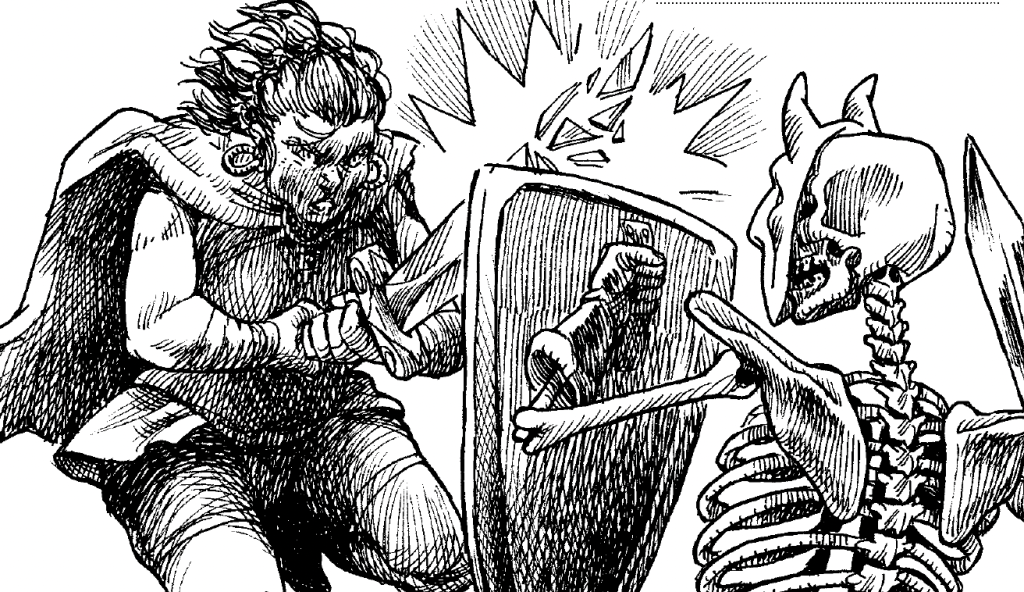
If the Basic moves are the core verbs, there’s only (“Persuade vs PCs”) which isn’t Dungeon World’s. They even take a strikingly similar format. Let’s compare Hack & Slash & Clash.
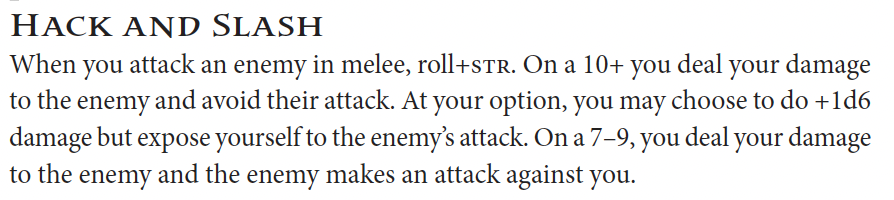
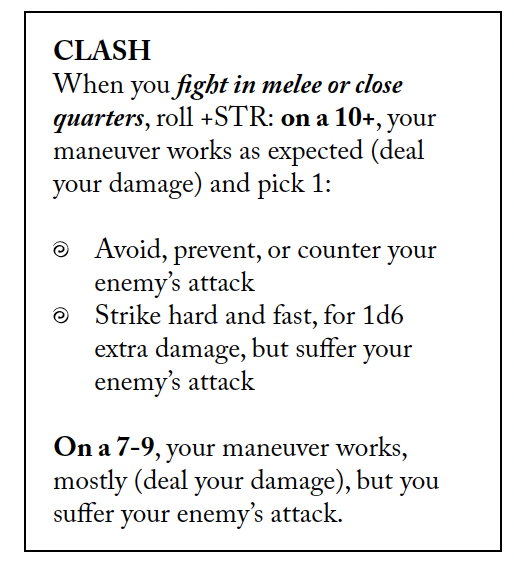
You can see the Stonetop one is more elegantly constructed and honed – don’t underestimate the impact of the name change, either – but it’s covering similar terrain. This is because this is a move which mostly did what it was required to do.
But let’s compare the two versions of Aid.
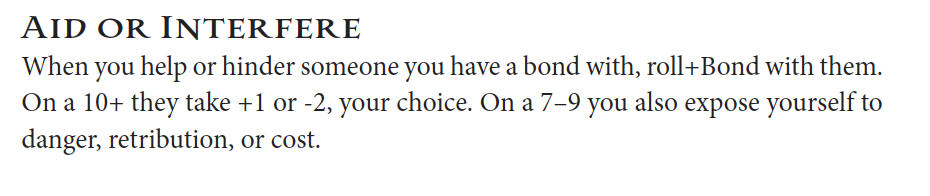
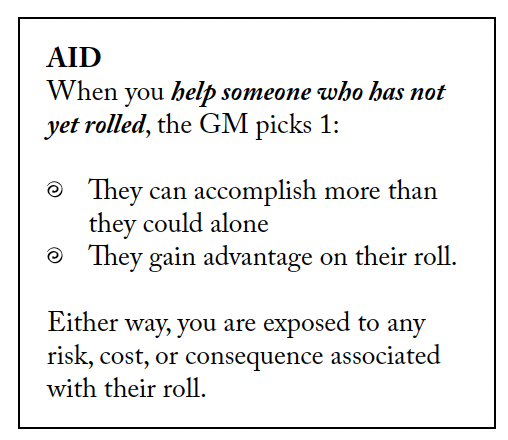
Oh me, oh my. We move from a move which is doing double duty for two very different things, only works if you have a defined relationship and always requires a roll (so slowing the game down!) to something that can just be called in the fiction, can impact the fiction in a way other than “+1” and has a simple, set cost that folks get. “Can I help?” is one of those repeated pressure points in a design, dragging. Reduce friction, increase meaning, go.
Let’s step from the basics, and compare and contrast a place where Dungeon World showed some real flash – what happens when you’re dying.
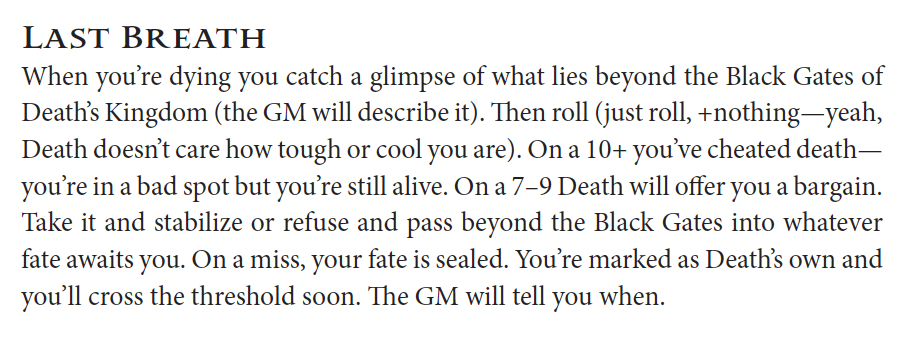
This works well in Dungeon World. It’s a high stakes roll, and the “maybe take a bargain with death to live” just sings at the table. However, Stonetop?
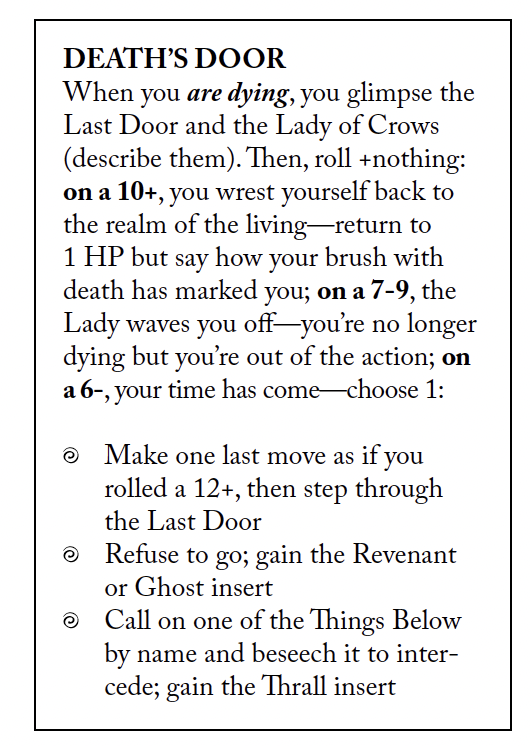
It’s better, from top to bottom. It’s kinder, in that it moves the 10+ to the 7-9, to create space for a heroic shrugging off the injury and getting back into the fray, but also makes the 6- not just the end of the game, but a place where you get to make some of the most interesting choices. 7-9 is clearly the best part of the original Death’s Door move, and it takes that with the Call To The Things Below (and includes materials to support it – the Inserts are basically add-ons for your character sheet), and then adds two other options which are just as cool. Consider the the move from “GM will describe it” to the player describing the Lady of Crows, getting a chance to define these final moments.
Stonetop is what happens if you take the core of a game, and then let very smart people kick it around for a decade, playing and iterating and tweaking. There’s a Brian Eno concept that comes to mind – Scenius. The idea that rather than individual geniuses toiling away by themselves, really good stuff happens with a critical mass of people noodling together, and their insights and perspectives inspiring one another. Dungeon World is certainly a game whose star has fallen, but had a world of smart creators and bloggers which Strandberg was embedded into, contributed to and learned from. This would include his playgroups, and the microtweaks born of playing with people, and what you learn from a game by actually playing it. There’s a decade of that inside Stonetop.
Because reading this, you’re aware this isn’t a game that hasn’t just been playtested – it’s a game that’s been played, and played, and now you get to have this crafted item. For those of us who weren’t part of those scenes, who didn’t go to google plus or wherever else, this game – from Stonetop, to stonebottom – it’s a blessing.
PBTA IS DEFINITELY NOT A CULT
Shortly after I got properly into indie-TTRPG, my wife got into Improv4. Like, deeply into it. On the London scene, formed a group, did festivals. So this gave me a front row seat to watching the subculture at work and play, and I just ate popcorn in delight. I learned a lot, and was interested in how it rhymed with what I saw in Indie TTRPG . Not in the way that Improv techniques can be used in games – but in terms of how techniques are taught, and their “play” culture and the idea of what good practise looks like in a creative form, and how they build a lingua fraca, looking for the “game” and so on.
(Also, a field where except for a handful of the very biggest stars, there’s absolutely no money whatsoever. That rhymes too.)
Anyway – at the same time, Bojack Horseman had just reached a series of inspired episodes where Todd joins an Improv group, and is repeatedly informed that it’s definitely not a cult. It’s using it to tell a Scientology story, except with Improv – but it’s also doing a Scientology story to gently mock Improv. Because Improv is definitely not a cult.
I thought of this all the time in the indie scene. With its love of structure, of learned techniques to maximise storytelling potential, of forwarding dogma to between enable freedom, I started quoting Bojack when listening to PbtA podcasts. This is definitely not a cult. Especially on the GM move side of it, it felt like the learned techniques. I didn’t disagree much (perhaps any) of it, except that it felt that it was just over-codifying good practise, and thus risks the problem of all over-codification – it becomes more about the law than what the law was meant to encourage.
But that’s the risk of anytime anyone tries to actually write stuff down, right? It’s the cost of doing business.
Apocalypse World rubbed some people’s backs up with its aggressive tone – fucking do this, loser. I’m in the corner where that was absolutely necessary then so folks realise they were serious. It’s not GM “advice”. Do this. The note behind the note was that the Bakers had no power to enforce this. It’s not as if they were going to arrive at your house and make you do it. It’s an attack against you just have a basic GM style you apply to any game and that broad Laissez-faire approach had to demolished. Why not try doing this?
Stonetop is lucky enough to arrive over a decade after those wars. It can strike a more conciliatory tone. Even so, it strikes a clear line and sticks to it. The Running The Game section opens simply: “There are dozens of ways to GM a roleplaying game. There’s a particular way to run Stonetop. This is how. The rest of the game is built on this approach.” It’s not as brusque as the Bakers’ Ur-text, but it’s as equally uncompromising.
And then it just tells you how. Step by step, it teaches technique and process, at every part of the game. It is simple, direct, and methodical. Do this, for this reason, and why. I can’t think of a game that has better explained how to make PbtA work. Hell, more than just PbtA. As other have noted, this feels like a guide to GMing that anyone could use, if they wanted to actually improve.
In short: Come on. Have your cult stage. If PbtA is a cult, it’s a magic school and when you break out, you still have all those magic spells. You don’t need to be stuck with your GM style, your own magic spells you’ve cobbled together. Try something else. To quote another bit of Eno, what woudln’t you do?
Stonetop wants to help you. It’s a teaching manual, not a work of rhetoric. You will learn a lot from this, as it kindly and insistently makes you better.
BUT NOT WITHOUT CLAWS
However, like most worthwhile teachers, also knows when to just show it’s not a pushover. The one page where it says what to do features this paragraph…
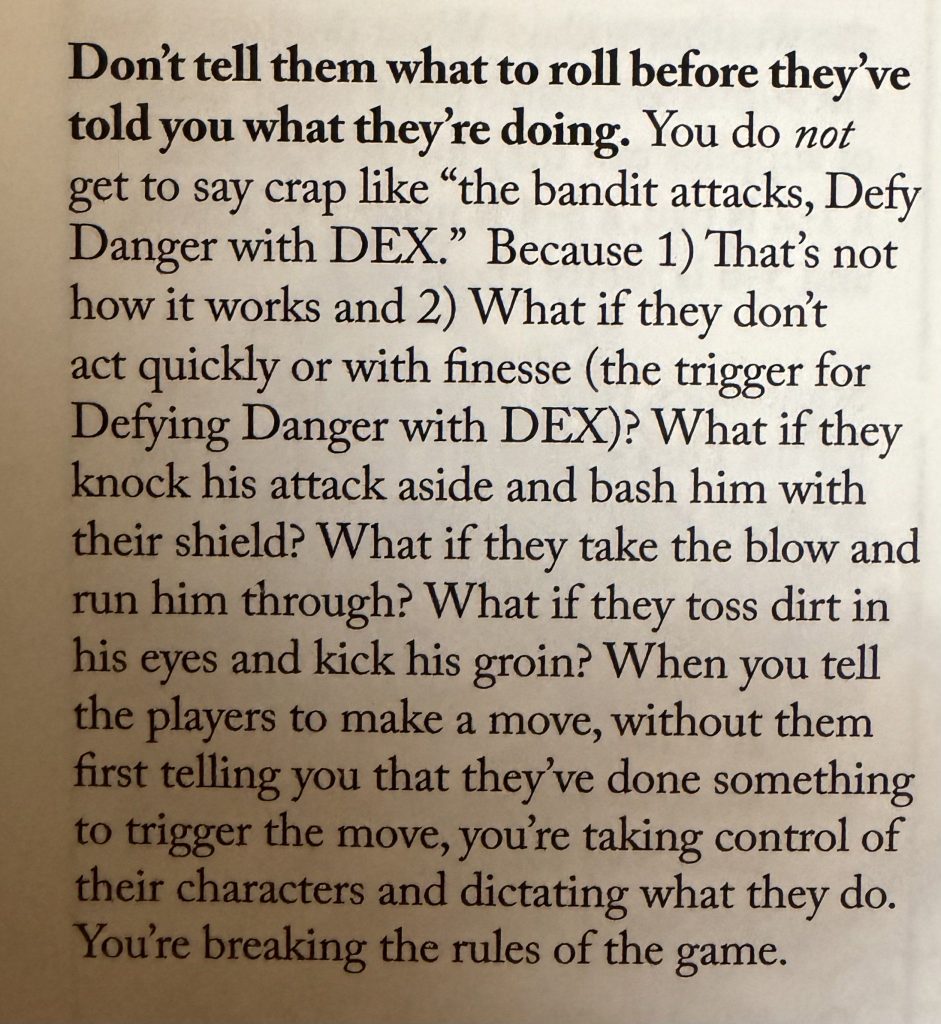
That single “Crap” is more effective in the context of the book than a lot of harder profanity in another book. That’s a teacher telling you they’re serious, as elegantly as they can. That it’s not what it normally does shows how serious it is.
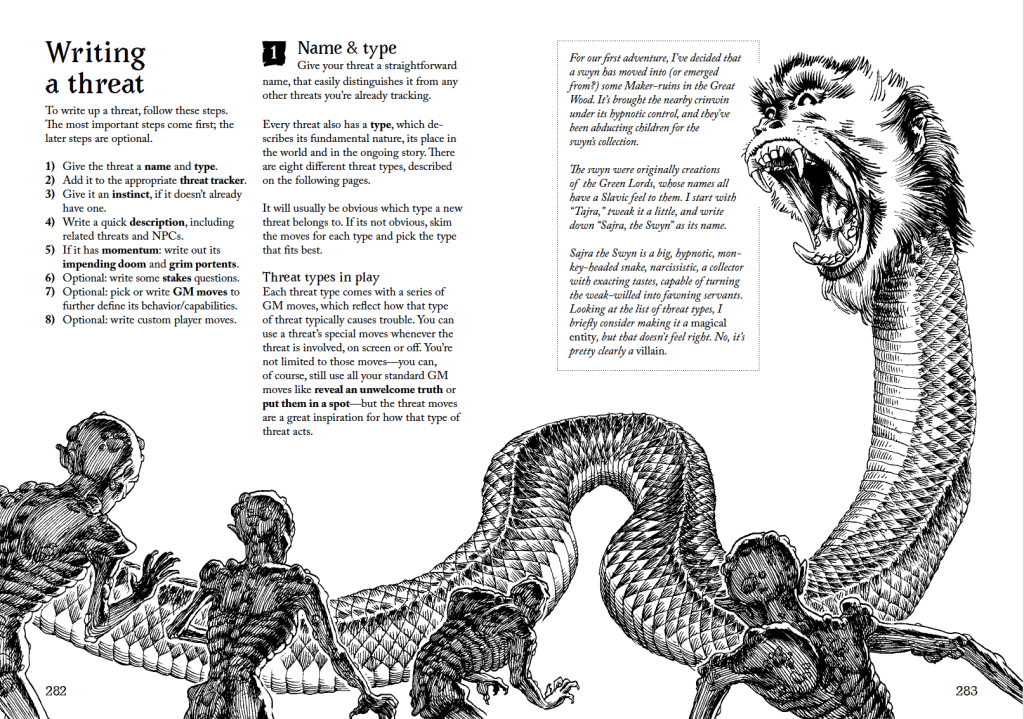
WHAT THE HELL IS THAT THING!?
Look at the big monkey-headed-snake-thing! Would hate to Clash and suffer their attack, right?
There’s a lot of “what the hell” anywhere you look, little details you just think “neat” or “wow” or “what was that big monkey-headed-snake-thing again?” What it does with the Inserts, with magic items becoming these little checklists, unlocking power and/or your doom. The playbooks manage to be both archetypal and specific in a charming way – and also flexible. Each has three separate backgrounds, which fundamentally alter the conception. The quick-on-wits Fox character is the Rogue archeype, but only one of the three backgrounds is specifically criminal – one is a prodigal (and anyone who’s been out in the world is very unusual in Stonetop) and the other is simply the smartest, most competent, natural guy in the village. You get to personalise in depth, but it also gives you a place to build from, the first brick in a wall. With nine playbooks, each of whom have three of these backgrounds, that’s basically 27 unique characters. When this is a game that wants long campaigns and small groups, it’s got more than any one group is ever going to see in here.
So yeah – beautifully bound, with striking, clean ink art, this is a gorgeous and evocative book.
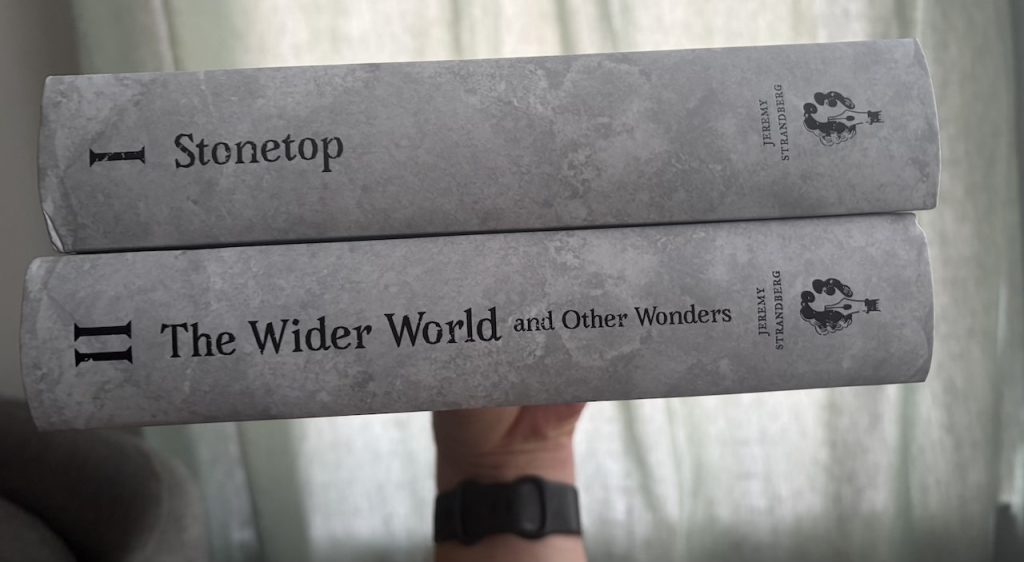
ACTUALLY, NO, IT’S TWO GORGEOUS AND EVOCATIVE BOOKS
The Wider World? I don’t think so. It’s slightly narrower.
Stonetop is the core game, including the procedures – but the Wider World is the wider world. The campaign setting – bronze-age, haunted by myth and previous eras. Despite the name, it also includes (and opens with, after the maps and basics) Stonetop itself, with a mass of material to run it, including the leading questions to personalise it. After that, the elements of the setting are introduced alphabetically, written not to be read through, but to be skimmed, to follow chains of meaning. Interested in the Green Lords? Ooh, look at the lords, greening. See a nice side-bar about the Fae? It includes their page number, so you can go nose.
Basically, it includes everything the GM would need to make their own campaign.
But it clearly wants to make your own campaign.
It’s a game which follows the tenets of PbtA, in terms of Playing-To-Find-Out, and certainly has a lot about the power of improvisation and letting players define elements of the fiction, but wants the GM to prep, to a level which is at least on par with how I’d run a trad game.You use the material in the Wider World, but then add a lot of your own.
Perhaps this is best shown in the chapter on Sites, where as its works through the checklist, and ends with including an example of the sort of notes you may write up for a dungeon. I’ve run Blades in the Dark and built Duskvol out of nothing but the warring of factions and vibes. I’ve ran The Between, and built a London solely from what’s on the Threat sheets. Stonetop’s example of a dungeon is seven pages. I’m not sure I had 7 pages of notes for the Between in total.
To be fair, it talks about you only needing to write what you need, and the amount can vary hugely. I know if I was running Stonetop, it’d be scrappier. It’s also very clear in showing what work can look like in a game like Stonetop. It highlights that “ask questions to let players create the world” isn’t actually dodging work, because to make good questions to ask is also actually work. And the Stonetop questions are masterclasses, in terms of merging exposition and player creativity. This level of prep is also, for many players, a plus. This kind of solitary fun is what the form ran off for a long time.
However, for this player, it makes me suspect I won’t be running Stonetop. Before I read it, I thought that would be because it’s a game which wants to be played for long 20+ session campaigns. After, it’s because it’s a game which wants more than I’m able to give between sessions right now.
There’s an irony here. After this initial look, my big takeaways are “Stonetop is probably the best PbtA textbook” and “Stonetop is the PbtA game closest to trad.”
Stonetop is available for purchase now.
1) Early and extremely successful PbtA5 game by Sage LaTorra and Adam Koebel. Basically, all the D&D6 conventions fired through the storygame filter.
2) I uses the technical definition of “Stuff that makes game go good”.
3) Set in Greg Stafford’s world of Glorantha, as a child, I viewed this bronze-age mythology-heavy game as kind of thing college students would play while sipping wine and eating fine cheeses, but latterly discovered you can play as someone who rides a buffalo. You should have led with that, guys!
4) I’m going to put the “Or Impro” down here, as rage bait.
5) Powered By The Apocalypse, the system debuted in seminal storygame Apocalypse World by Vincent and Meguey Baker.
6) C’mon. Don’t play.

Kieron Gillen lives in Bath, for a certain value of the word “lives”.