It is this organ’s firm and unyielding belief that one cannot review an RPG from reading it. You can review a manual, certainly, but you’re not reviewing the game in any meaningful way.
However you can skim and see what pops out.
This is the Skim, and this is what we got from skimming Mythic Bastionland.
IN A SENTENCE
Kieron: It’s OSR1 hexcrawl2 Pendragon3 in miniature4 (complimentary5).
Reviewing role-playing games is a controversial business. There’s some people who believe you can make a meaningful judgment about a game by careful consideration of its manual, and there’s other people who understand that’s nonsense.
You don’t need to read a game to review it. You can just look at its cover and make all the judgements you want. Of course, some people say you shouldn’t judge anything by its cover. Those people sound like the sort of people who didn’t have all their games stolen on the way home from Gencon on the train back to my home.
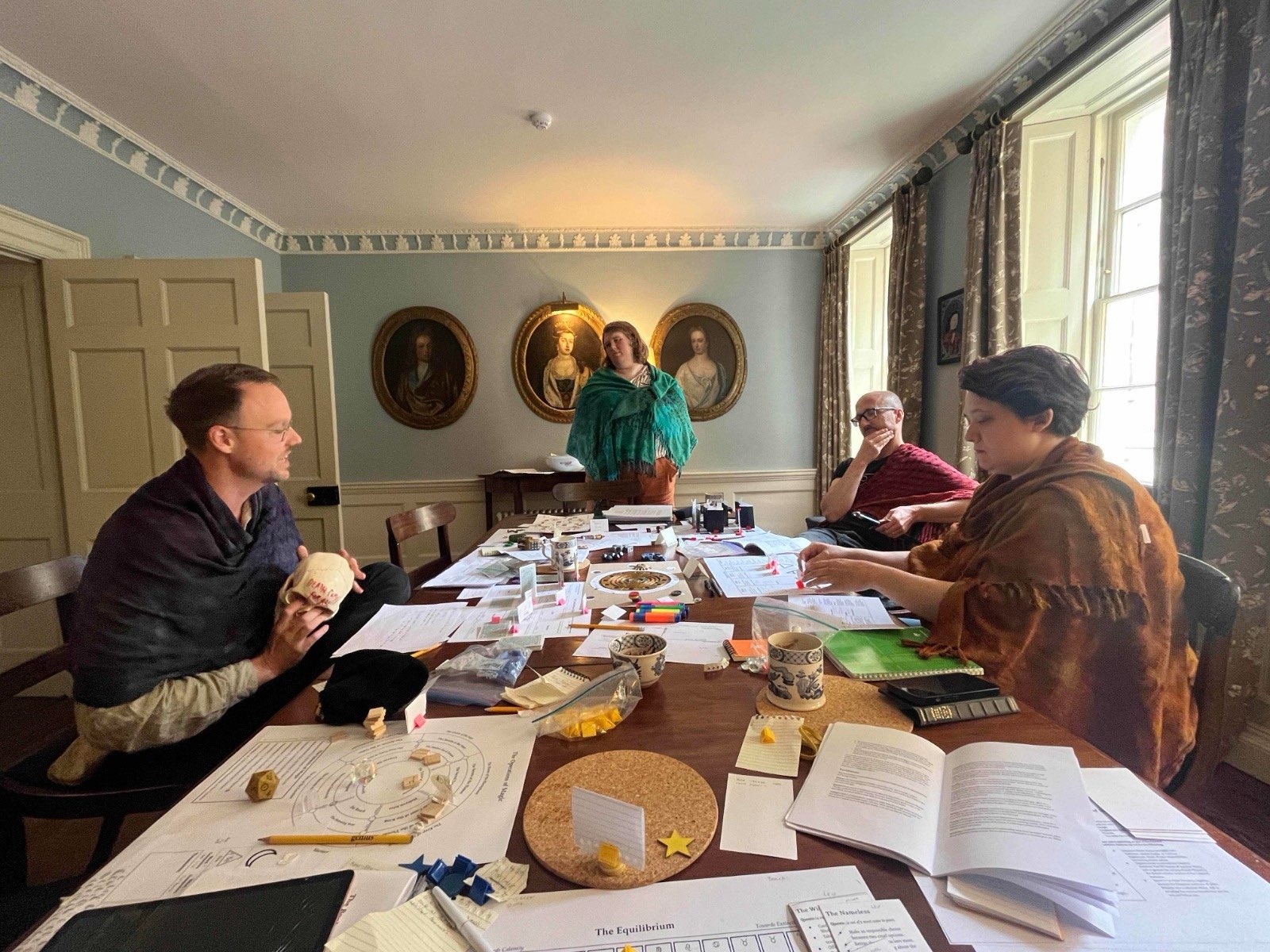
Jim, Kieron and The Mysterious Third (Chris) have a regular group. We’re forever GMs, and play short campaigns where two are forever GMs no more. This is Threedom, and these our our stories.This time we report on Beowulf: Age Of Heroes.
Kieron: I’m smiling at your notes for this chat, Jim. “Oh no, we played 5E! Sort of.” The ‘sort of’ is carrying a lot of weight. Handiwork games seem to be folks really who are interested in bending 5E significantly, and there’s a lot of that here. As the basic intro Beowulf is set in the world of the Anglo-Saxon poems about a Danish hero who kicks the ass of a monster, and then its mum and then has a bad time with a Dragon (though kicks its ass on the way out). The game’s got a lot in, but its core thing is as a duet game – one GM, one player. That’s about all I knew going in – Warped 5E, literary-historical-setting, duet game. Is that a fair description?
I was probably making a cup of tea, as I usually am.
I just stared into the middle distance and thought “all role-playing games are either High Art or Fanfic” with a force that made me know that it was fundamentally true – which meant, on some level, it must be fundamentally false.
All dichotomies are false. You can never take this too seriously, as it’s a classic The Map Is Not The Territory trap.
However, given a certain definition of Fanfic and High Art, I think it’s can be a useful map. When I say “a certain definition” I mean “Mine.”
I’ve released a new game zine! You can grab How Do Aliens Do “It”? here, which is a pay-what-you-want-or-not Carved from Brindlewood game about Alien teenagers in a repressive, information-scarce society gather to share what each of them knows and try and work out how doing “it” works, and how they feel about that. It’s a playful game which tries to approach big stuff lightly, and I’m really happy with it.
And for those who want to know the process, here’s the designer notes (which are also in the game)…
Look, ma, I can do clickbait titles. I’m a real boy content generator now.
I wasn’t going to call the article that. It’s very much what I’d use if I was 20-30 years younger on Youtube and forced to try and engage with that hellscape. Instead, I am on a blog: an elegant weapon, for a more civilized age. I don’t need to do it. I am, because while the blog is a lightsaber, it is a lightsaber made of shits and giggles.
Jim’s note: this was previously posted on the TEETH RPG newsletter. (Sign up! Share with people!) I’ve added some subsequent thoughts to this, because we played it even more since I wrote this.My promise to “write about Mothership” became something of a joke on the newsletter, taking me a couple of years to reach this incomplete conclusion. But at least it’s a start, eh?
Mothership. I Finally Wrote About Mothership.
I was poised to write something about Mothership a while back, but a couple of things gave me pause. Firstly, my group really wanted to play another game of it. We weren’t sure we were “playing it right”, and felt like we needed to give it another shake, just to make sure the wrinkles weren’t ones we’d put there ourselves.
These originally occurred in the DIE Arcana beta. I’ve tweaked them a little to give any perspective born of bringing the game to completion.
The early drafts of DIE RPG were mostly written in a mode which Grant described as Uncle Kieron leaning over to you in the pub and ranting enthusiastically. Some of that remains in the final book, as one can’t purge that level of avuncular horror that easily.
However, one thing I don’t talk about explicitly is what I was trying to actually do. And so this is basically me answering the question “Hey, Kieron, wtf you doing here, man?”
My primary aims were to:
Support the themes of the comic in a different medium.
Jim’s note: a version of this article was originally published in the wonderful, the singular, and the dramatic TEETH RPG Newsletter! Subscribe for these reasons.
I had planned to write about setting-agnostic rule systems, system-agnostic settings, and the way in which we sometimes hack one game to work with another title’s adventures. I admit that some of the reason for this was that I really like saying the word agnostic. What a beaut! Agnostic. I relish it. This proposed essay, if I ever write it, and let’s assume that I already have, links to something about vibes in dice rolls in a later newsletter, building up a sort of coherent commentary on RPGs as sampled and adapted literature and the quilts of meaning that we build out of related cultural materials. {I am actually working on this, soon. – jim}
As you can see, great stuff is already happening in my imagined future.
But in the present something more important arrived from the past: I remembered a game of Feng Shui.