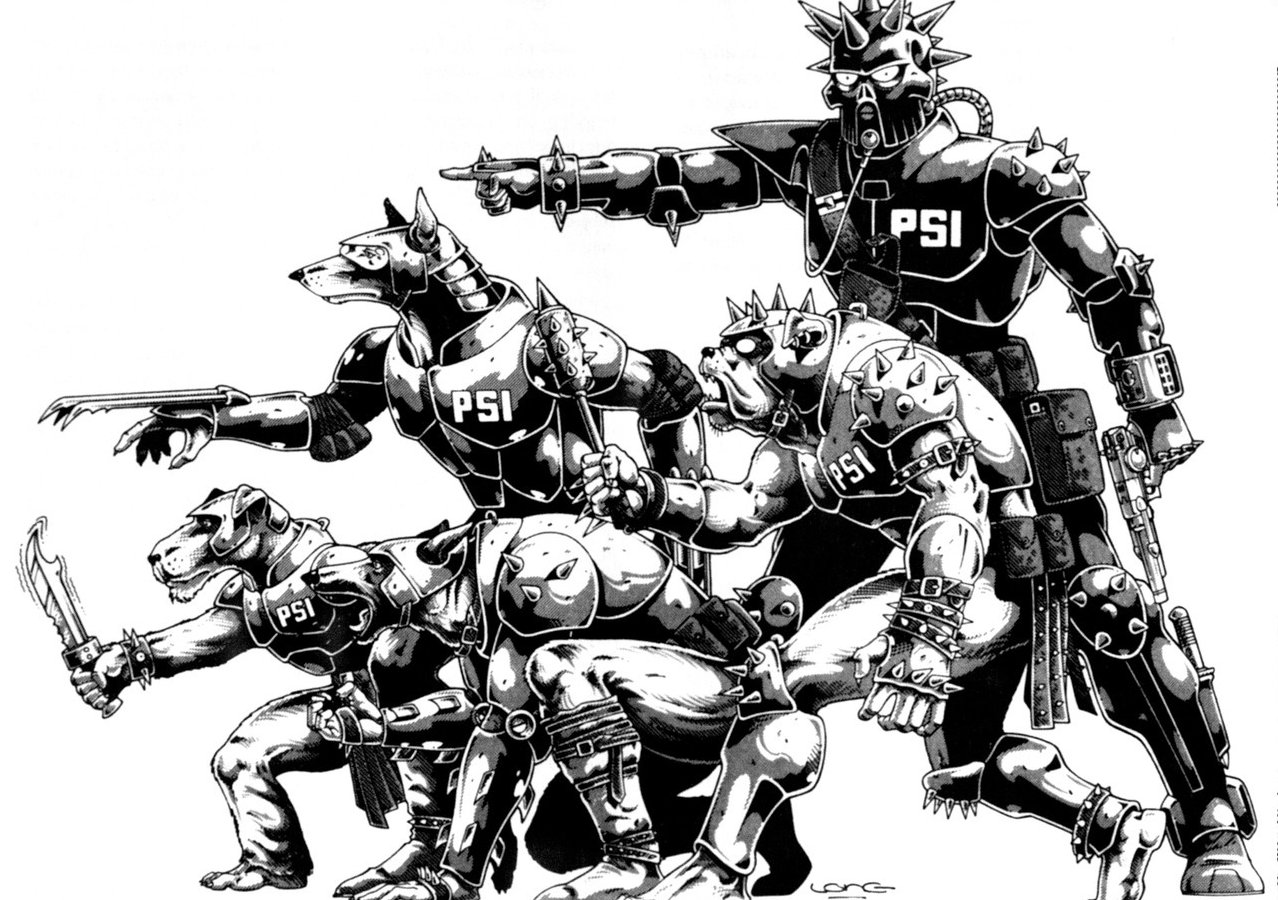
Just two RPGs dominated my imagination from 1987 to 1996: TSR’s D&D and Palladium’s Rifts. A few years ago I did go back and run a couple of D&D campaigns, with a far more competent and organised (and better financed) approach than I had as a kid. It was good! The experience reminded me that “GM” is one of my key character class abilities, and subsequently I went on to start running stuff regularly, to the point where I now produce TTRPG material as a mostly part-time job of work.
Rifts, though, had a different story.
Primarily: it was lost. The big pile of books had been loaned to someone, and I could not even remember who, exactly, by the time I work up from my early-20s booze haze and groggily looked around for them. I had a fair idea, but I wasn’t sure, and I didn’t want to bother the guy. After all, we had drifted apart! I didn’t really play TTRPGs, it didn’t really matter. Then, about 25 years after I had loaned them out, I got a message from the suspect. “My wife says I need to clear out some stuff before I can get any more things. Do you want these Rifts books?”
And so they came home. Oh baby.
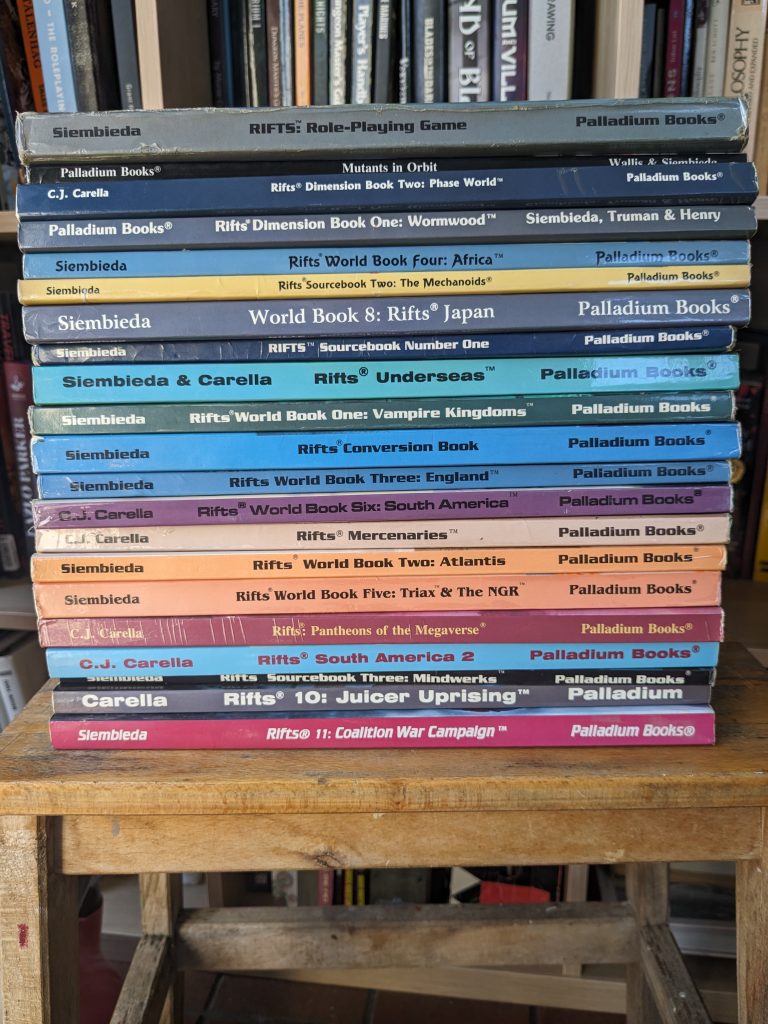
To say that Rifts was formative for my gaming habits would not be remotely hyperbolic enough. I have, of course, talked about this elsewhere, but to be brief about it: I found the genre-busting salad of it to be freeing in a way that teenage me had not realised was possible. Drug addicts and dragons? Techno wizards and terminator Nazis? I mean, that last part doesn’t feel quite so exotic at the present time, but for teenage me in 1994 it all combined to an eminently huffable cocktail of what seemed like a pretty transgressive blend of body-hacking, reality-warping, and dimension-splicing. Cowboys and wizards high fived over the corpse of an evil robot. It was joyous.
I did not, of course, get on particularly well with the Palladium rule system. That’s something we’ll come back to later in this discussion. For now though, I feel like the important part of this is to say that what powered my interest in Rifts, and indeed powered their entire business model to this day, was an interest in the voracious world-building that took place in those Michigan offices. They made a sourcebook for abso-fucking-everything. Every part of the world had one or more books detailing factions, unique character classes, and ludicrous weapons to be found in that location. Arthurian England! Demonic Russia! Japan! Futuristic aircraft carriers! Atlantis for some reason! Because Rifts was about extra-dimensional apocalypse it also had books about other worlds, other galaxies, and other dimensions, some of which were clearly just a completely different original game that had been sewn into the system like a third arm on your Frankenstein’s monster.
But that was a good thing! My interest, as a kid, was less in systems, less about the rules, and more about being able to read about a fucked up future Germany where people got in mechs to fight gargoyle armies, and then sit down at a table with my friends and say “this week you’re going to be freedom fighters in a fucked up future Germany where people get in mechs to fight gargoyle armies.” It worked brilliantly.
(Much the same was true for D&D of course: we were forever creating new characters so that they could be agents of Waterdeep, or escaped slaves in Dark Sun, or space mercenaries in Spelljammer. I buy a new thing? You expect to be fighting space mind-flayers by Sunday.)
All of which I can now see probably both missed the point of Rifts, and also completely ignored the opportunities (if not actually explicit tools) that the setting offered GMs. It’s in the fucking name, dude: Rifts.
Rifts, in the fiction, are points at which leylines cross and the world tears open. These leylines (yes, the druid shit) had been supercharged with psychic energy after a nuclear war killed millions of people at once, and this meant the nexuses of the lines opened voraciously, allowing travel to other worlds. And also aliens and demons to invade in the other direction. Yes, in case you had missed the setup for Rifts, that’s the whole backstory. The entire explanation for why the setting allowed for everything.
I absolutely used the titular rifts all the time in our games. A rift would open and they’d fight off interdimensional slavers. Or a rift would open and they’d go into the blight dimension, or get on a cool spaceship in Phase World, or whatever.
But it never once occurred to me that this immensely prolific setting, combined with a Fast Travel Anywhere In Any Reality tool, meant that we could and should have been doing a Monster Of The Week setup. I failed to sustain a satisfying campaign because I was forever fleeing to the net thing. I never let my players develop their characters, because when a new sourcebook came along, I just had them roll a new character and off we went exploring the jungles of South America, or space, or a different space in which there were wizards, or whatever.
Rather, Rifts the game system (implicitly, admittedly) wanted you to create a team of heroes who could go anywhere in reality, and then come home again. It’s the Stargate setup! Come on man, I think across time to teenage me. I did sort of get this, with our final campaign being set on Phase World, a hub city to one hundred dimensions and the three galaxies of The Galactic Empire, The Galactic Wizard Empire, and the Galactic Space Ninja Empire. (All three were at war, of course.) But it was too late.
So here’s the setting for the thirty-years-later campaign that I will never run.
The player characters have ended up in the wilderness of North America (the default setting for the game) and have been saved by a Ley Line Walker. (These are powerful type of guy who use leylines to do stuff, and can open rifts if they’ve levelled up enough, which this one has.) Mr Walker is a useful patron, because he can send them to other dimensions but, significantly for the failure of imagination of teenage me, to other places on Earth, via the rifts. I never clocked this. If we did an adventure where they had to travel, they had to do so laboriously over land and sea. They never did make it to Mexico (I think I bought another expansion before they made it) but in this setup they could fast travel within the rules of the world, and then home again when the vampire carnival had been dissolved in holy water.
Anyway, this allows for the Monster of the Week format that also allows me to dabble in any and all of the settings while — importantly — allowing for there to be an ongoing thread of character development which makes the characters matter. The Juicier (the drug fuelled mega-warrior) can actually burn out and die! The partial cyborg can become fully converted! People can fall in love or be lost to a hell dimension (similar) or any of the other things that should be happening in your TTRPG campaigns. All the things that teenage me left behind in his excitement to make someone be an anti-monster.
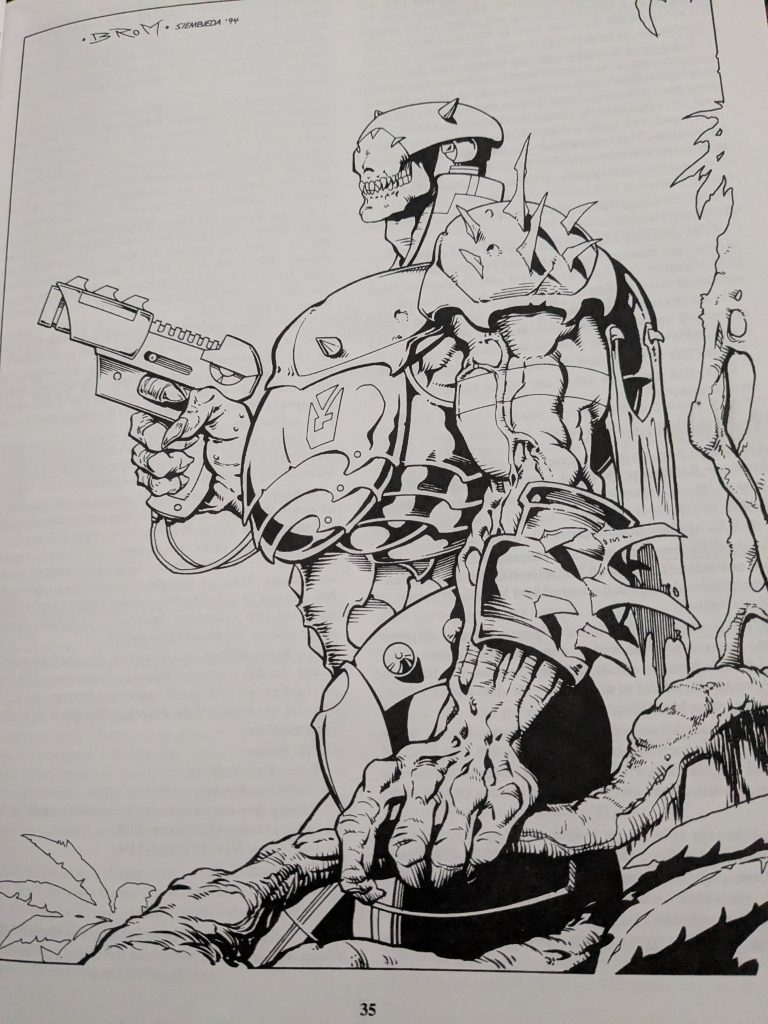
[Inner Teenage Jim: Look man, the anti-monster was awesome: a bio-magical cyborg built by South American cultures in response to extra-dimensional threats. Like a technological cyborg, it was a person at heart, but rather than having machinery crafted into the biological core, they were pieces of magical biological material. This was absolutely an idea that a Rifts writer made up on the spot to fit this cool piece of original Gerald Brom art, actually Siembeida seems to have commissioned this specifically, and I love it and still love it and somewhere on a long abandoned hard drive there is a dreadful piece of fanfic I wrote about the adventures of the anti-monster in a jungle that turned out to be dream or something.]
So that’s the framework. Pretty obvious now that I write it down, I guess because I am not 14 anymore, but the real question is: how would I run it? What system? What fistful of dice?
Now, the truth is that teenage me and friends spent about one afternoon trying to run Rifts as it was written, with its many numbers, absurd “mega-damage” system, endless tables and stats. And nope.
Instead we ended up with character sheets full of numbers that players would essentially make a narrative argument to me with — “come on mate, my Crazy can’t be affected by mind control because he has no mind to speak of!” — and then I’d set difficulty on a d20. Later we realised that the d20 was a pure hangover from other trad games and, since we were doing it purely based on vibes, a d6 would work. No such granularity required. Did they need to roll? I’d make up the target number. Was the robot they were shooting at really big and slow? You could only miss on a 1. Purely made up to fit the situation. Dice fudging? You bet! If they needed to survive, I’d just change the number. It was perfect.
Better, though, and adolescent to the power-fantasy core, was that we kept the damage values of the weapons. Did the player have a plasma cannon that did 8d6 damage? You can sure as hell bet he got to roll 8d6 and then take that from the hit-point total of the alien-intelligence they were bombarding. That was the best bit of Rifts, and we kept it faithfully recorded and enacted. Everyone was happy.
Which is not to say that would work now? I mean, maybe. But there are other options. Rifts ended up getting adapted to the fairly friendly Savage Worlds system, which although I have not yet played, I did read that comic strip that explains how it works, and it sounds okay to me. Perhaps I’d do that.
Or perhaps I’d run it in a conversion of Trophy Gold that I just imagined. That seems like a hack that the internet is crying out for? Right guys?
Guys?
[Update: Kieron says what he meant was that I should write and then run a game inspired by Rifts. So that’s different. I didn’t understand the assignment, and I apologise. If you read this essay and then one day play a future game that meets this brief, see if you can guess which one it is.]

Lost in the hills of Somerset, this Rossignol searches for meaning among the clattering of small plastic bones.


Leave a Reply to Shon Cancel reply