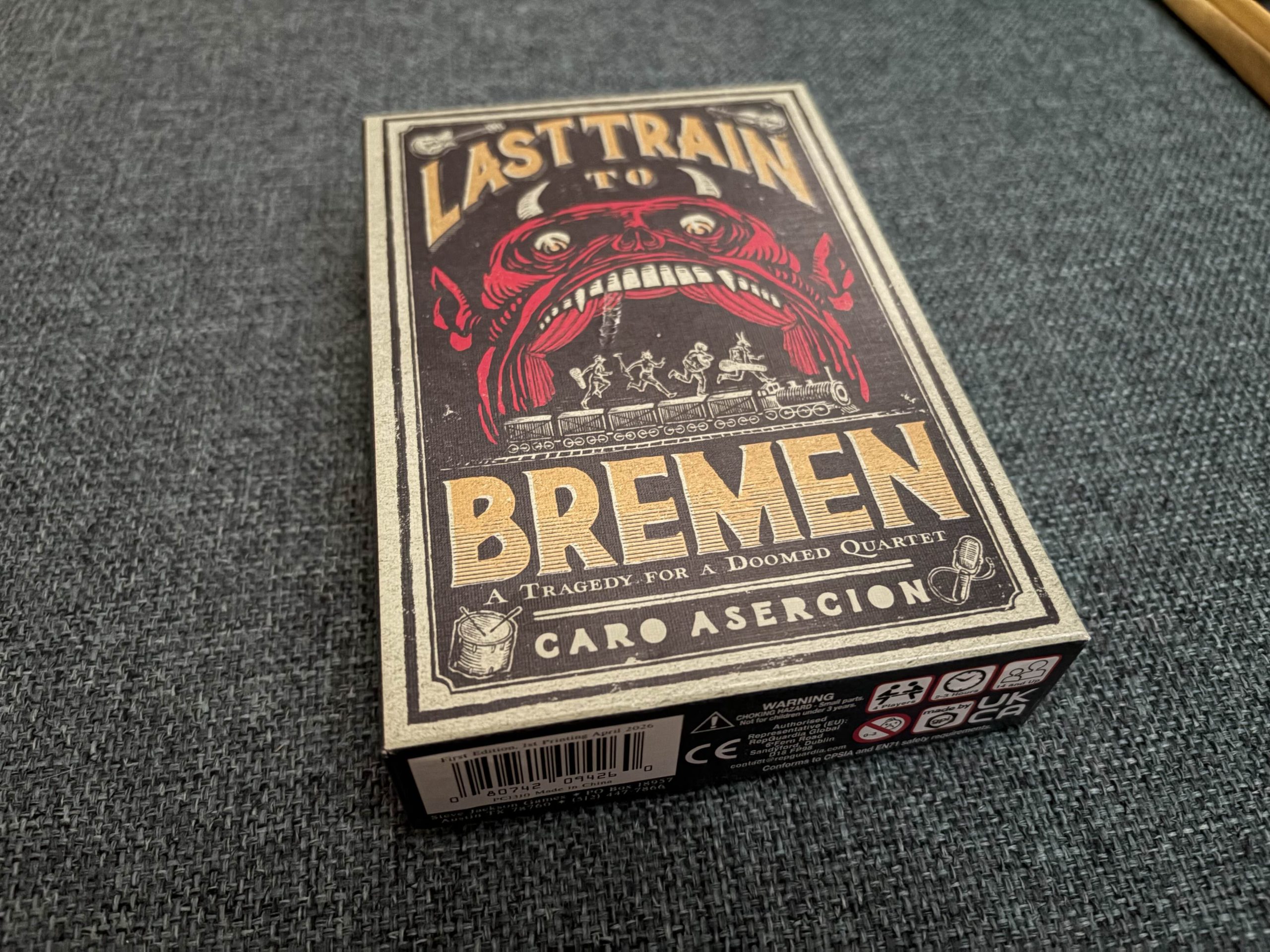

We played a game about anthromorphic animals! That doesn’t happen often, so we thought we should review the experience, for you.
Jim: We recently got a chance to play Last Train To Bremen with two people who were not Old Men, but are certainly ruling the world, Philippa Warr and Dr Emily Friedman. A real game at a real table with real human people! It was a lot of fun. But we cannot review the experience of hanging out with other human beings. Instead, let’s talk about this, a game that a number of people have recommended to us in the past year.
Last Train is a GMless story game by Caro Ascercion which mixes folk tale Town Musicians of Bremen with a measure of US folklore about trains, crossroads, the devil and so forth, to produce something that has a distinct flavour and energy in the way that artful cocktails of beloved ingredients often manage. It sees four players, and it requires precisely four, to take on The Cat, The Hound, The Rooster, and The Mule, who then play a version of Liar’s Dice to decide how things pan out as they take The Last Train To Bremen, and attempt to skip out on the deal they made with The Devil.
We’ll get into some of the meat all of that in a moment, but I wondered, Kieron, if you had any idea that Richard Scarry’s version of Musicians of Bremen was one of my favourite stories as a child, is seared into my brain, and consequently I imagined the entire sequence as if drawn by Richard Scarry?
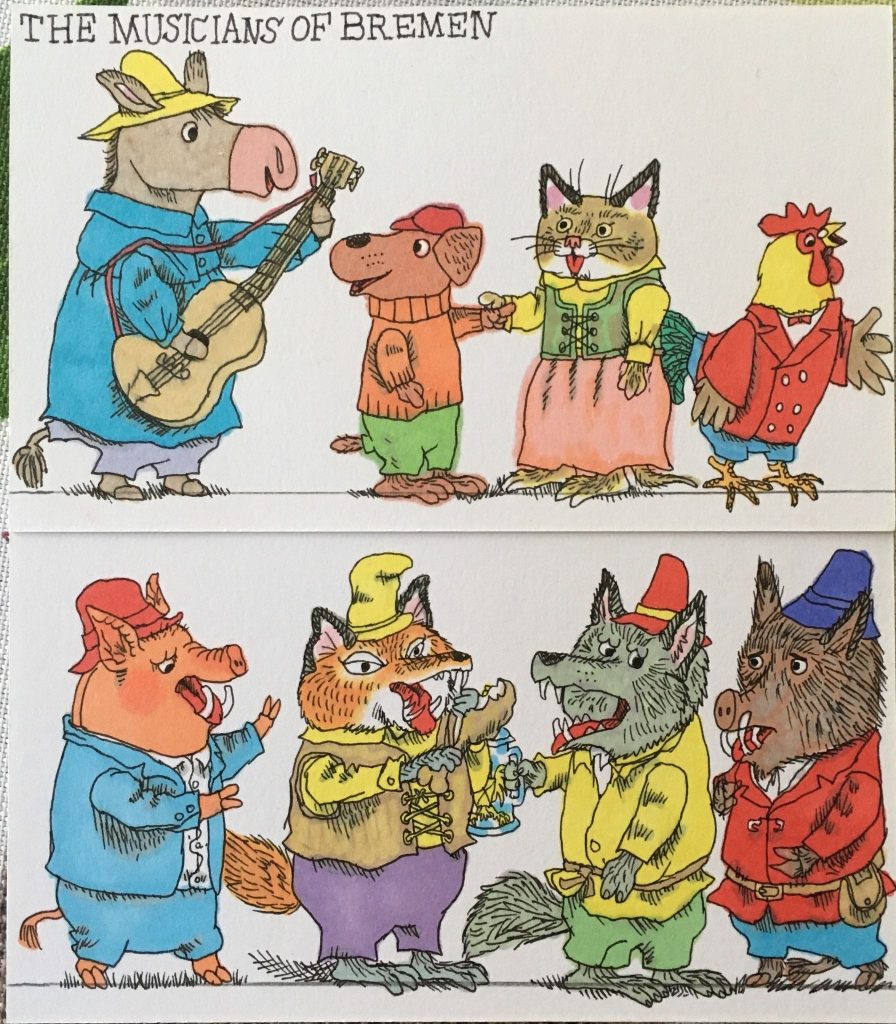
Kieron: Amazing. I had no idea it was one of your favourite stories. I also had no idea the story existed in this form. I also had no idea the story existed in any form whatsoever. Cat, Hound, Rooster and Mule as the four characters now make a lot more sense to me.
Scarry is rocking it there. In my head, it was playing out like the material I did know – which is basically, a million and one rock documentaries, the pictures summoned by the music press and my own time back stage in sleazy, crappy bands who (as anyone who heard us play will confess) definitely didn’t make a deal with a devil for supernatural ability. I suspect the Devil knows a lost cause when he sees one.
Jim: So I think one thing you mentioned at the time was the amount we tended to play GMless games, which is like, not a great deal? I have played Fiasco, Thistle & Hearth, Ironsworn/Starforged, and I think that’s it. And that was interesting as the evening went on because I felt like I was flexing a muscle I didn’t use much. Even being a confident and practiced GM I felt a little out of my depth with Mule, who was a fair typecast for me: reliable one, took care of the money, and so on. I did feel myself having to reach to get anywhere. Also, I was fucking terrible at Liar’s Dice, so I felt like I was doomed on all fronts, not just the one where we were being dragged to hell.
Kieron: I think I’ve got a bit more experience with GMless games than you – with the exception of DIE RPG all my own released designs are GMless, and DIE RPG has an unusual amount of GM-as-player. But it’s interesting how it’s a game which actually merges Liar’s dice – as in, a skillset you can actively learn and display system mastery – and storytelling authority. It’s a game of chance and odds, of course… but they are things one can learn and be better at that. It may be luck, but it felt telling that the person who won was the last person standing in Hell, was the one person who played it before.
To get specific, we all play these four iconic figures on a train to Bremen, and recapping how we got there, and playing dice. The shape of the story is guided by the prompts on each character’s sheet and who wins and loses the games of liar’s dice. When you lose, you’re prompted with a bit of the back story and narrate your memories of it – and encouraged to work in the person you beat in the details of it. I think being new we didn’t do great at that, but the prompts’ escalating story structure held it together. The person who won then gets to add their own commentary – though it’s all duelling narrators and unreliable arseholes. That the core of Liar’s dice gets derailed quickly as folks unlock special abilities perhaps pushes against the “May The Best Liar’s Dice Player Win” aspect to the game, but I’m not sure it bothered me at all.
Though I did last longer than you. Did it bother you?
Jim: I was first off the train and I think the only thing that bothered me was that I had got to grips with the ideas the prompts had invested me with, and I was just working towards doing something with that when I realised it was time to go. I mean, such is life I guess, but there was an extent to which I realised that losing was not being able to do something with the thread I had uncovered, via prompting, for the Mule. It’s interesting seeing this experience in the light of my “how to get better at improvising” article, because I felt like I did not immediately find my feet, as if all my advice in that article went out of the window. I think you mentioned during the session that it was unclear what it would mean to replay a story game like that, but I would absolutely want to replay it, just as I might want to replay chequers if I had just learned the rules and could see a route to doing it better next time.
Which is not really a ludic thing here, for me, like I can see that the rules might prohibit me having anything tactical or strategic to draw (the radical rules-changing stuff that the game allows you to choose are breaky of that sort of approach) but I do think I’d handle telling the story differently! And this has something to say with regards to the Liar’s Dice layer working with the story-telling aspect: it’s interesting that they are essentially abstracted. When I had heard about this game previously I had understood the playing Liar’s Dice to be what the characters were doing on the train. Like they were sat there playing a dice game on their way to hell. But actually that part is what the players are doing, which is outside that fictional circle. I mean, I have no idea if there is a way to cross that boundary, but it meant it was not the game I imagined I was signing up for in that regard.
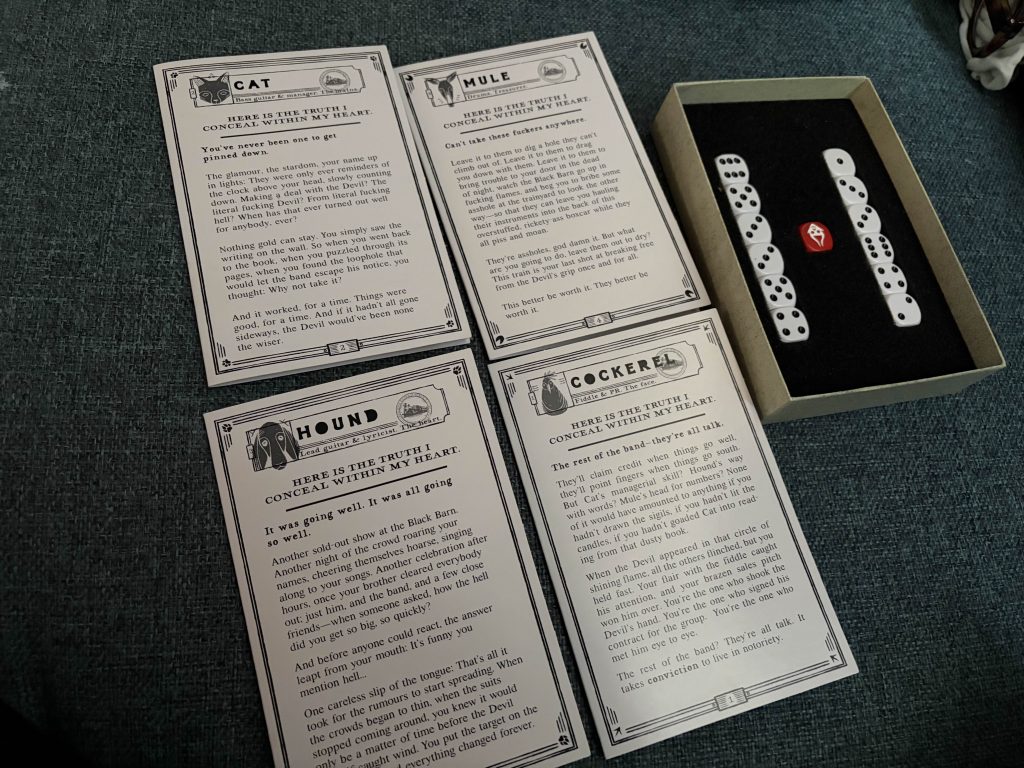
Kieron: Yeah – I don’t think it tries, and it (perhaps surprisingly) doesn’t matter. It is so much vibes, because Liar’s Dice is a game which is loaded with things which just feel slightly salacious. Your characters are playing Liar’s Dice… but the liar’s dice game you’re playing is not the game the characters are playing. The resonance between the two is the thing which ties it together. I find myself thinking about sympathetic magic – do the thing which resembles the effect you want to happen, and it happens. We are playing dice. They are playing dice. We’re connected by that magical thread. It doesn’t make sense, but it’s enough. Could it have been any game? I suspect not. If they were playing Kerplunk and we were also playing Kerplunk, it’d be silly. Liar’s Dice is just well chosen, for many levels. And the boxed edition of this is just a lovely evocative thing.
I think I’ve convinced myself me being fine with it was actually fine.
I agree about replaying it – I’d certainly take it out again. That the person who played it before wanted to play it again says a lot, right? I’m also aware that while its potential story space is much wider, my immediate response to playing this was suggesting we all play For The Queen – a game I’ve played more than a dozen times. I think you’d make bigger, bolder moves in the fiction knowing how short the runway was.
Jim: I want to play it again, too. (I also want to play For The Queen again, and explore the hinterland of stuff that I know was inspired by that, but I haven’t touched on.) It feels like a really good party piece for what story games can do generally. And I think for a thing with such a light touch — a few bit of scene setting to read in a rotating fashion around the group; a few prompts and choices to be made by the individual animals, which reflects their setup and allows you to decide where to take them — it’s remarkable in conception and delivery. Just a beautiful thing. And that’s before we get to it being a delightful physical package in this form. Really just good.
It is interesting that I have been thinking so much about bands recently and then this comes along. It’s also very much accessing a leyline in the landscape of your own mythology: the interplay of people in bands, their interactions, the magic that this produces (as, if not more dark, than light). Riffing off what you were saying about sympathetic magic earlier, I can’t help thinking, when sat with stuff like this, about how magic resembles games and vice versa, and that this had precisely that intersection of ritual, make-believe, and pure invention which both forms are fertile in.
Kieron: Oh god, yeah. The whole oracular nature of dice is something that’s very much my jam, and if folks are interested, I have a comic series to sell them. Obviously, the whole band thing is very much my jam – us immediately going into “so… what kind of music are we playing?” is very me. The game has some fairly engrained rockist tendencies, with the four members being bass/drum/lead/fiddle-singer, but that’s still a fairly wide space, and there’s nothing in the prompts which speaks to what they play in the band – just the role in the band. You could hack this to any group of four creatives involved in an endeavour. Some would be harder (various characters have prompts connecting them to a venue, and it’d be trickier to turn it into a KPop group… but also not impossible.)
Really, this is fun. Hit a classic faustian myth in a couple of hours, and make it your own. That said, it’s also less purely archetypal in the specifics than you’d expect in the roles too. Take your Mule, for example. The Drummer being the treasurer of the band? Spreadsheets aren’t exactly what one connects with the drummer stereotype – unless we’re doing mathrock, I guess.
That said, the drummer did die first, which shows we were embracing the spirit of Spinal Tap.
Jim: And that’s what TTRPG is all about.
Last Train To Bremen is available now.

Lost in the hills of Somerset, this Rossignol searches for meaning among the clattering of small plastic bones.