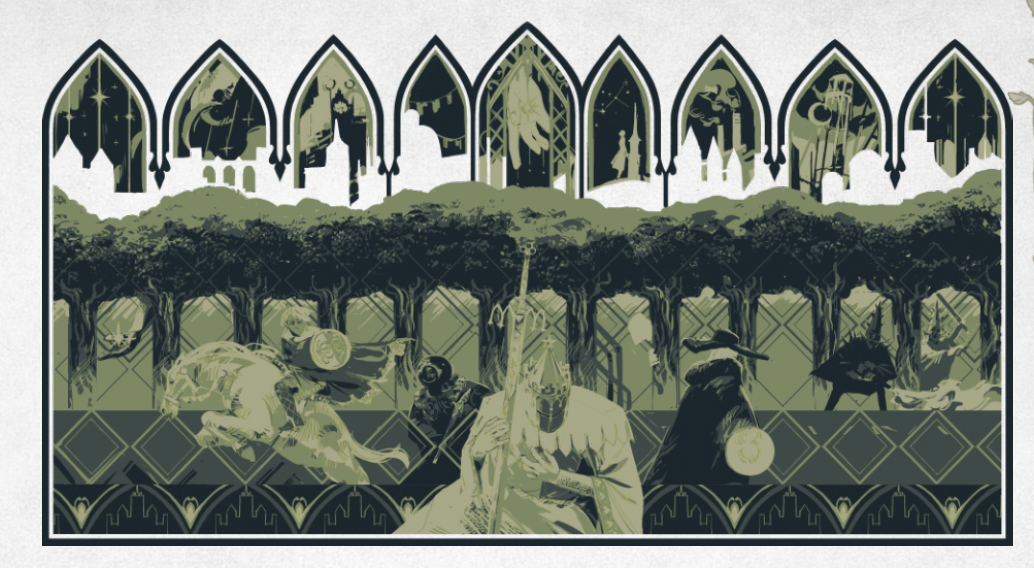
Mythic Bastionland, the latest game in Chris McDowell’s Bastionland series, was one of the best-smelling books we had ever encountered when it arrived last year. But some people suggested it mattered how it played, and that was something we could not discern from residual ink-scents alone. To find out, we rolled up our chainmail sleeves, watched John Boorman’s 1981 knight-based masterpiece, Excalibur, and then dove headlong into the lake where there was probably a sword or, if not, some sort of wretched wyrm of myth with which we might wrestle in the dark and wet.
Rossignol: Hail, brave Kieron Gillen. We should open with some sort of brief pitch or summary of what the game is. I would say it’s a game where the players take on the rolls of mythic knights who arrive in a mythic realm to track down myths in a mythic hex-crawl, and during that they do some talking to NPCs, and some combat where they never miss (never myth?) because this game has a coooool combat system that we absolutely loved. And it’s all quite good! Is that a fair summary?

Gillen: It is. I was struck that the one liner we cooked up in our The Skim was on the money: OSR hexcrawl Pendragon in miniature. It really is! Though I suspect I’ll loop back to how we one conceives of the game also creates the game you play. I generate a realm. The Knights interact with it. It’s a real place… and then these seventy-two lovingly created myths start messing it all up, and it’s up to the heroes to do something about that. There’s a lot more in the detail, but the game I expected was the game I got and the game I got was exactly what I wanted. I think “Quite good” in the American more than British sense. This is my favourite thing I’ve run in forever.
Rossignol: A key observation of mine was that I have rarely seen you do gasps and chuckles at GM’s private dice rolls as routinely as you did during our Mythic Bastionland campaign. You really did seem to be enjoying yourself. Is this a game designed for GMs to do a chuckle, Gillen?

Gillen: It is. It both matched and challenged my basic play style in running anything quasi-trad (as in, adventurers, adventuring). The way I do it is basically the classic “prep situations, not encounters” mode – I make up entities, give them goals, and have them act as they would to the players’ actions. That’s Mythic Bastionland, really. However, I’m also using a lot of Blorb-adjacent approaches and actively resisting thinking about narrative direction – which isn’t part of my trad toolset. I talk about this a lot in the Smiling Fox episode I was on, but using the spark tables and the generation process I made a sketch of a living kingdom. As you explored, I generated more of it, as required. When they were conceived – either from the sparks or the core idea – the entities in that world act according to their goals, so I had all the backdrop to the events. The king who had lied to his children for fifteen years about being injured, leaving them to run the kingdom and be driven away, all so he could try and trap his ancestral enemies into a final battle: everything cascaded out from that, all from the spark of something like “INJURED PILGRIMAGE” and rolling him as the FOX KNIGHT. And then with those datapoints, everything emerges.
And then the myths arrive into this world, and alter it. The game’s rules for this are robust and simple, and I was able to turn it to anything in the genre I required. But when this fairly realistically rendered world was absolutely kicked around by the vagaries of myth was where the game just sung. The whole section when you were trying to lead an army to take a castle to cut off the invaders food supplies? That’s great by itself. Then The Mist kicks in, and you’re wandering around in the gloom, trying to find the castle. And then, when near the castle, The Wheel kicks in… and now it’s suddenly winter, and the rules make it clear you’re all going to freeze to death if you’re outside. So now you have to take the castle somehow, which you do, and then there’s a siege when the retreating invaders come back and also want to try and get inside…
Now, that’s a good example of how it works. You had the situation, but this is why I’m laughing on the other side of the board. You were going “we’re fucked” but I was also running the invaders thinking the same thing. I worked out their marching speed across the hexes, so there was a real timer on how long you had to take the castle. When they arrived, I was thinking of their general and what they would do, knowing their men were starving and weak – and also the advisor who you guys knew fifteen years earlier, when you sent her running out of the kingdom, who had her own take, and trying to work out how to avoid being executed by her new boss.
With Mythic Bastionland, at least how I’m running it, I feel a lot like a swan. You see a lot, sure, but there’s a lot of things you’re simply not seeing moving around. Hell, you may never see. I knew things like “the arguing couple you met in the second age of the game, had another six kids and then the wife died and the husband has been raising them alone ever since.” You never went back to that vineyard.
I was also giggling a lot as I was being scrupulous about the fortune rolls when I was unsure about something, and I rolled 1 so many times it really as if you were cursed.
It was also a really good excuse to listen to O Fortuna on repeat, which is always my idea of a good time.
I’ve ranted at this bit, as I think it’s actually my reservation. It’s the game I worry about where my level of fun is higher than the other side of the table. Is that a problem? I dunno. It depends on how big the gap actually is.

Rossignol: I had an enormous amount of fun! For reasons we will get into later. But just to pick up on that last point, yes, I did feel like there were issues with the opacity of events for me as a player on the other side of the table. Is it more fun as a GM? Maybe!
The omens for the myths (strange events or circumstances, appearances of characters and so on which take place as a myth unfolds over a number of encounters) are unclear, deliberately of course, but they were also both calls to action and situations which at times made it even less certain what was going on or what we should do. I think we struggled with that at points during the adventure, particularly as things escalated and got into a fairly twisty political drama across a long period of time. The experience felt a bit swingy to me: the machine was clearly there, running the world, and sometimes that felt chaotic and other times it aligned and (as with that sequence with the march and then the siege) it all proceeded in a growing, escalating way where you could absolutely feel the magic coming out of it. When all the wheels and cogs were interlocking it was a motor. And that happened most of the time, just not always in a player-readable way, I think. This reminds me, actually, of all the essays I wrote about simulationist approaches in videogames, and of how procedural systems often generated better situations that designers might author, you just have to trust in the mechanism. Sometimes it can make it confusing, of course. Why are the bandits attacking the building you have been sent to in STALKER? Well, that’s just the dice rolls playing out, sorry.
But what I was getting to before that diversion was the surprise of how political it became. I had expected massed battles and growing old, but just how much the world ended up being a simulation around us in terms of NPCs (really, I had expected a game almost purely about hunting down myths) was a real surprise for me, and it meant that Mythic Bastionland felt much bigger than the book read, if that makes sense? Again with that procedural/emergent theme. I think there are elements of that in all RPGs, what is it but a story emergent from some text that’s running on brains and dice? But in Mythic Bastionland it felt extremely potent, concentrated and refined.
Gillen: It’s an interesting illusion. I remember being at a games conference in Australia, watching a presentation of someone who was recording sessions of a game being played and breaking down things according to time. It led to the observation that Mario is a game where you spend 87.2% of your time (or whatever it was) moving on a 2D plane. One reason why Mario is such a great game is that they nail that feeling of movement. It’s a basal level of pleasure. Most of the content of the game isn’t moving on a 2D plane, but at a core, it’s that.
Mythic Bastionland plays a similar trick – you have these fifteen pages of rules, and the vast majority of the book is myths – but those pages are the engine. They’re the core of the thing. The myths are a huge body of material which distorts and interacts with the core system. I may write up some notes on running Mythy B, but the core of it really is that – the myths are what changes the world. The more you have a handle on the world, the more you can work out what happens when it’s foggy for fifteen years due to reasons (myth reasons).
Rossignol: I am going to put an aside in here to note how interesting game design becomes when it takes a base game and then throws in modifiers which blow up the default. I am thinking here of the boardgame, Cosmic Encounter, which was a staple of ours for many years precisely because it threw such incredible rules into the mix, via the aliens’ unique powers, that each game had the sort of emergent wildness that myths bring to Mythic Bastionland.
Gillen: I found myself thinking of them as incredibly developed random encounters – like random encounters that eat smaller, lesser random encounters alive. It’s a game which runs off huge, fundamentally random, fundamentally chaotic additions to the story, but are thematically flexible enough to integrate with whatever else is going on. They’re weird, but they chime.
Basically I agree the game really was this big political emergent story… but I also note our intent at the start. We came in with me pitching it as Pendragon in Miniature, and we created that. I’m also aware I wasn’t forcing hands anywhere. You absolutely could have ignored this world playing out in favour of just being myth busters. I was trying to run it as a player agency game – but I was also running it as a sandbox with its own life, and I let the game fall where it will. That invasion you defeated? Maybe the invaders would have won, and then they would have become the new rulers of the place. I had faith in the simulation of this world being interesting, and I wasn’t disappointed in it.
I think it’s worth getting specific. Want to talk about its combat? Everyone seemed to like it.
Rossignol: Combat had a few levers, but at heart it was enviably simple. We selected the weapons we were going to use, and rolled the relevant dice. This meant we usually had a selection ranging from d4 to d12. We could also push this by adding a dice for a Smite, or making it blast to hit a group of enemies, which risked being exhausted(a save against losing the ability to move and attack in the same turn) each time we did it. There was no rolling to hit, just a case of assigning the dice that you rolled. The highest would be assigned to damage (the number with the enemy’s armour value subtracted), and then anything on a 4+ could be used to perform a “gambit”, which was an additional effect, like impairing an enemy on their go, or stopping them from moving. Enemies get to roll too, and did so after the player-knights turn.
So there is no “oh i missed, nothing really happens”, which I think all the groups I play with agree is an unpleasant beat in trad games, but it still manages to be crunchy with choices, options, consequences, tactical moments. That, Kieron Gillen, is the good shit of RPG combat. Fast, simple, but super consequential and rewarding of decision-making. (Notably, an evolution of the other Bastionland games in a way that was very knighty.)
It also, to my absolutely amazement, did not lead to the deaths of what appeared to be incredibly fragile knights. I am sure this was largely chance guided by your hand, but it was also a remarkable experience at the table.

Gillen: You guys had really strong luck in combat, and people who could have wiped the floor didn’t land that blow. There were some times when I could have been more ruthless, I suspect, but that’s normally married to times when you guys were being really foolhardy, and killing Ogan and the Moss Knight when they were very old men sleeping in the woods with 2 vigour between them a short ride away from their actual castle seemed perhaps inglorious. Other times it was me looking for ways to make things interesting, like in the penultimate session when you were trying to walk away with the child from this open battle between Seeker knights. How to do that?
That I did handle it with the combat system speaks to it – the gambit system you describe is just so flexible. Yes, you’ve got a list of basic stuff you can use – that example with the Seeker Knights’ core was your friends trying to stop the seekers from moving after you and you trying to get as many extra moves as possible – but it could be anything. One of the most memorable battles, for me, was when you finally hunted down the Hydra after thirty years, and you and the two betrayed children of the original king forgave it to death – all running with gambits. That’s what the game really does – it gives a really strong toolbox that you can apply to the situations which emerge.
It’s also very specific in how it beats you around. Normally in a Hex Crawl, it’s a question of exploring and finding what’s there. In Mythic Bastionland, it’s true – there is stuff there – but you basically randomly encounter the nearest myth 1 in 3 times you move and a random myth 1 in 6. That means that half the time you move, you encounter something which pushes forward one of these events. One of the player oaths is, you seek myths – but the myths really very happily seek you.
Rossignol: The myths as mega-encounters presents as an unusual experience. You could come at them from precisely the opposite angle and say they’re mini-adventures. But in neither case are they necessarily linear, although they have progression, because the omens mean you experience them more-or-less piecemeal across time (although the opening wolf myth I think we did one after the other with little interference). What this means is that myths are incredibly distracting. We’d be riding off with an aim of, say, consulting a Seer about a problem we had with the weather getting stuck on winter, and a completely different omen would cross our path. What was that leading to? Should we risk investigating? Could we afford to ignore it? Did it mean anything at all? Were we up for a jolly? Who would care about this? It meant that it was incredibly tempting to just go off the path, diverting attention from one myth and trundling down the path of another, which itself was a recipe for escalation since the myths proceed down their omen tracks and effectively get worse if you don’t deal with them. Maybe some self-resolve? I am actually not sure.
Anyway, what I think I liked best about the myths was the sheer inventiveness of them. We were dealing with widly variable situations throughout the campaign. Some of them were allegorical and psychological (like The Hydra, which also felt like the most dangerous), others strayed into fairy-tale resolution (The Goblin), while all of them felt suitably mythic (The Wheel) and others ended up being disgusting moral dilemmas (The Troll, which… let’s not get into that). The Wolf Pack in the opening encounters were clearly supernatural and the omens were potent, even if we did fully understand what we were seeing. That was part of the entire experience, I think. Confusing sometimes, certainly, but it was how knights in a mythic reality interpreted their world. We wandered into a realm, it was beset by myths in the finest tradition of such things, and we did our best, as knights, to ride out and face them. It’s as close to a literary knight questing game as I think we are ever going to get, without ever really having authored quests to go on. The quest was our lives!

Gillen: That we embraced the ageing part of the game really increased the mythic scale of the game. A hydra that’s been a peril in the kingdom, and must be endured is a big deal as an adventure. When it’s been around for thirty years, it’s something else. We got so much great energy from things we experienced as young people coming back in our old age. It’s one of the things which really impacted my side of the table – the woman who became Queen defied her husband for a lovematch. Now, due to the way the aging rules hit him and his statline, I took it to be that he was enfeebled in his old age, so their relationship has that right at the centre. That her own spirit crashed prompted me to lean into her depression. That the heir was an arsehole came from a spark of jealousy against you… but when he aged into the most competent knight the kingdom has ever seen? That’s something else. What now? What now when our heroes can barely walk?
It’s interesting that so much of this just comes from seeing the rules for age jumps, and wanting to put them at the heart of the game. Chatting to other GMs, it seems players are resistant to it – they don’t want to leave problems unsolved! Which I get, but was never a problem for us. If something was an immediate problem? We didn’t age jump. But solving major myths seemed to be a great prompt for an age jump. This was the age when the mist lifted. This was the age when the hydra was repelled. This was the age where the fate of the child was secured. Plus, with the political sweep and scale of the game, there was so much more room for the myths to become mythic. The myths are a light touch, offering essentially sparks to the GM. For example, the Hydra’s one-liner title “Punishment for Past Sins” became much more potent when there were actual past sins to be punished. The Child being finally dealt with when you were very old men became a symbolic passing of the age – that the campaign ended with you talking another child into not being an arsehole is some potent stuff, right?
If I could give people running Mythy B one tip that isn’t in most other tips, it’d be that: age jump often. If there’s a major thing that has just been resolved, and there’s nothing else that’s a MUST SOLVE, do an age jump. What happened in the gap? Life happened. Beowulf lived a life as a ruler between killing Grendel’s mom and having to face the dragon. It’s just that those were the really important bits. When you touch the questing seasons, that’s the point – these were the periods where things changed. Embrace you’re telling a life of knights. Embrace you may tell a story that outlives everyone at the start of the game, in the Pendragon Arthurian mode. Arthur isn’t born at the start of the Pendragon cycle. It gives you something else. Hell, if I ever did come back to Mythic Bastionland, I’d be tempted to jump an age or two on from where we left our little realm, and use sparks to inspire where they are now. Things like Ellery’s Road stretching the map, with your old characters talked of as great heroes that you perhaps will never live up to? I love it. Or maybe I’d do a new realm. Because that’s the thing – you completed eight myths. There’s another sixty-four in the book. I could play this again and again, without ever needing to go and buy another adventure.
That’s a thing I love about Mythy B. It’s an OSR game with a strong narrative flavour and rejects the “it’s all about the adventures” in favour of “Here’s a book with much more content than you will ever need” while also having rules which are perfectly crafted for the specific material presented. I often read OSR rules and think “This is flour”. I read Mythy B and think “This is fucking cake.”
Rossignol: Yes. Excalicake, I call it. Delicious!
Mythic Bastionland is available to purchase now.


Lost in the hills of Somerset, this Rossignol searches for meaning among the clattering of small plastic bones.
Leave a Reply