

It’s Star Wars day, and while I haven’t time for my Let Me Show You How Star Wars Actually Operates Via PBTA Moves, let’s try something else. There’s a lot you can learn about how to make your characters better by actually watching Star Wars.
I spent a few years writing Star Wars comics for Disney, which led to me studying them intently with adult eyes. The film which grew with rewatching was actually A New Hope – just this fairy tale, and a deeply strangely structured one. For all it being Patient Zero of The Heroes Journey in Hollywood, its lead doesn’t turn up until twenty minutes into it. That doesn’t turn up in the How To Write a Screenplay guides.A tight look at New Hope reveals stuff people forget (and whose absence is why some later stuff doesn’t land) but also a whole bunch which can make you make your writing (and playing) better.
This is transferable to games, as much of what makes Star Wars work is in the cast’s acting, not the dialogue per se. Not what they say, but how they say it. We have all these lines that have become part of pop culture, quoted until they’re worn thin. Actually look at Star Wars, and see these are performed with fear in the heart and sweat in the eyes. Folks look panicked. They are committed to it, absolutely. This is a long way from the action-as-videogame-cutscene that’s trapped the genre’s heart in Carbonite.
Anyone can make jokes about Storm Troopers’ accuracy. Easy. What you should notice is that there’s no point in the movie where the characters don’t run away the second they’re outnumbered, or treat the threat with the upmost sincerity. It’s not until Jedi we discover what happens if they stand and fight, and can ‘t run away – and the answer is “They get captured.”
And then there’s Han Solo.
Han Solo is the archetypal Han Solo in fiction. Generations of role-players have tried to play knock offs. Generations have shat the bed, as in their Love of the Effect of Han Solo On The Screen have failed to grasp how the magic trick worked.
It’s not just Han, of course. It could be Wolverine. Or any cynical loner who refuses to play by the rules, is clearly cooler than anyone else in the story, and really doesn’t want to be involved.
You know the sort.
What we’re talking about here is one of the classic gaming complaints of those in the trad space. As in, someone grinding the game to a halt with a “my character wouldn’t be involved in this adventure.”
Now, I’ve found myself reading D&D Reddit, and… oh, let’s embed the post.
There’s a whole lot of stuff, and a mixture of good advice, terrible advice, and a whole world of clashing play styles.
But, were I to paraphrase the hardline advice that pops up when someone asks what to do about a player whose character doesn’t want to go on the adventure, it’s something like…
Just let the party go ahead, and tell the reluctant player that their character has gone off and done their own thing and is now out the game. If you want to carry on playing, roll up a character who wants to be involved in the game.
At which point I am gritting my teeth and trying to avoid barging in the walls of the Internet like the Kool guy going on about This Is Why Buy In is important.
But even that’s not helpful if someone wants to play Han Solo, because Han Solo – almost by definition! – doesn’t want to go on this mission, really. Are we really saying that you can’t pick this clearly popular archetype? After all, Han Solo has to be dragged backwards through the movie to be involved, and everyone loves him.
This is the moment everyone is thinking of.
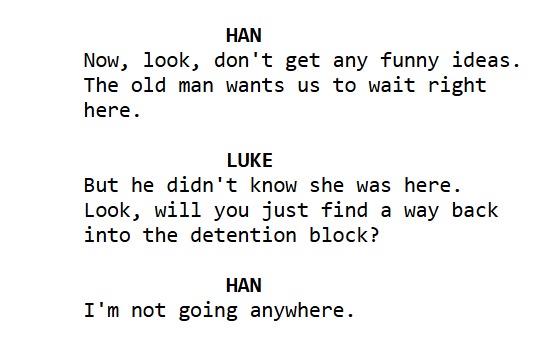
But the important thing to remember is…
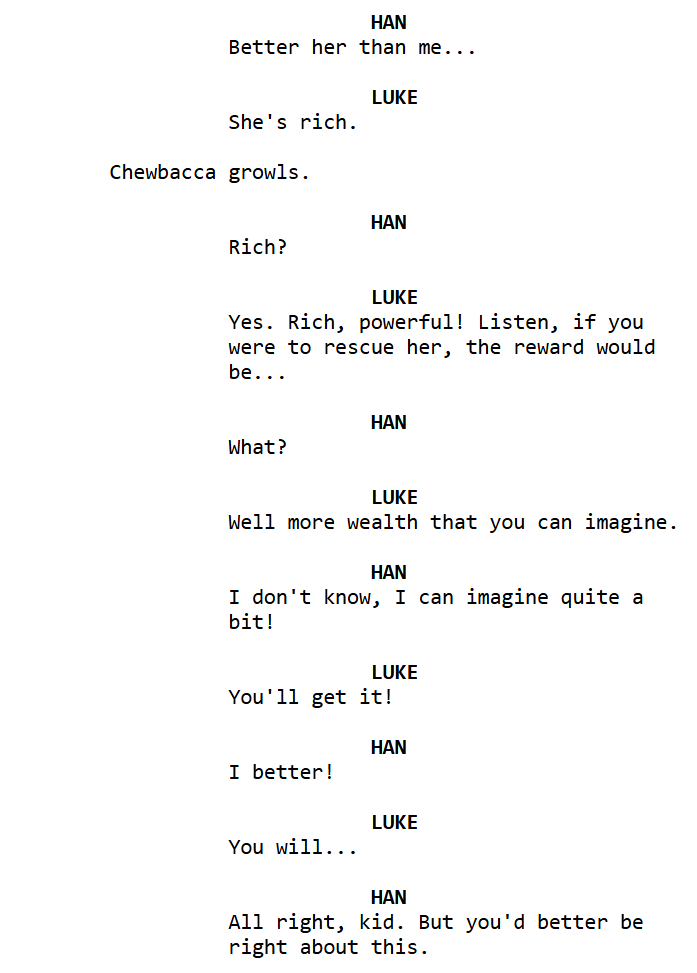
Now, if you are looking with naïve eyes, you may think “this means that it’s the party’s job to convince the reticent character they want to be part of this game.”
This would be missing the key fact that Han Solo is a fucking idiot.
Imagine if Star Wars was an actual TTRPG. A classic Han Solo-esque player would have told Luke to sling their hook. It’s clearly a threadbare suggestion, and incredibly risky, and it all hangs on the say-so of this fucking farm boy they just picked up who’s already lost their old dude.
But the player of Han Solo in the film? Oh no. They’re all in. This half-arsed suggestion is all he needs. What they’ve done is used their character trait to create a scene which lets another player shine, and then buy into their answer completely. Rather than using it as a blockage, they’ve used it as a springboard. Rather than worrying about being cool, they have let the other player be cool. Which makes them cooler.
The fundamental mistake that a wannabe Han Solo player makes is thinking that it’s other players’ job to convince them they should play – when it’s in fact, by choosing to play an awkward character, it’s your job to work out why you remain in the game and go along with what’s happening.
It’s interesting that we’re used to thinking about Player Skill intersecting with the character class in terms of efficiently using the skills the class is based around… but we’re less likely to think about the character type in the same way. I think they’re actually identical.
If you’re playing a Han Solo finding ways to stay in the party is your problem in exactly the same way that working out how to throw a fireball and not kill your entire party is your problem as a wizard. If you didn’t want it to be your problem, you shouldn’t have picked the fucking class.
We love Han Solo for many reasons – but above all, we love Han Solo because he remains in the movie, on screen, and doesn’t leave at the forty minute mark, never to be seen again.
Because the one thing Han Solo never was, is boring.

Kieron Gillen lives in Bath, for a certain value of the word “lives”.
Playing an asshole CHARACTER can be a lot of fun (for everyone at the table), as long as you are a generous PLAYER.
I read somewhere long ago that the role of Wolverine in the X-Men was not just to challenge Cyclops’ leadership, but to challenge, allow Cyclops to get all butch, and then back down and go along, albeit with a grumble. Wolverine’s role was to set up Cyclops to look all leader-y.
Kiri: Well, now I feel foolish writing all that when I could have done it in a sentence like you.
Steven: In fiction, characters are all about interactions. The point is the dynamic, and it’s something we can use well in play. I forget the LARP term, but leaning into other people’s characters really helps.
The larp term may be “play to lift”?
That’s the one!
This is perhaps WHY the advice to let them wander into the desert or whatever exists. Theoretically, it would remind the player that THEY want to participate, so they’d better find a reason their character does, too.
(Of course, it’s a pretty passive-aggressive way of doing things, and one that the advisors have likely never themselves used.)
So when do we see the script through that lens of PbtA moves?
Oh, half the fun of blogging is teasing things you never will actually do.
(Since this we actually the Old Men have been chewing it over occasionally. Maybe we’ll do a micro-PBTA zine or something.)