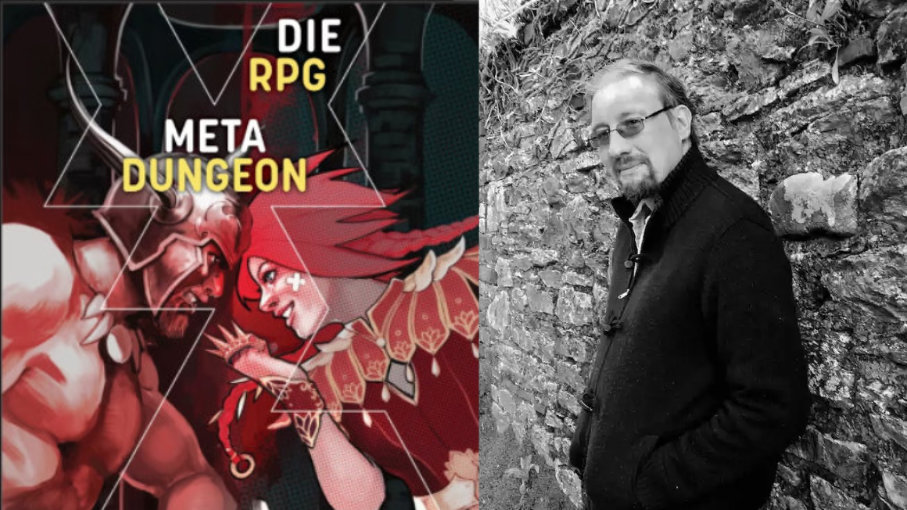

The DIE RPG: The Metadungeon is presently crowdfunding as part of the Mega Dungeon Month. It’s a frankly ludicrous endeavour, born of Gareth Hanrahan going “how about a dungeon which was also a playful history lesson of the form?” I ran an interview with Gar in the back of DIE: Loaded 6 but it was cut to shape and had a bit more editorialising. As such, here’s an undirector’s cut for where Gar’s head is and where he wants to take everyone…
You messaged me with this idea almost as soon as DIE RPG was announced, right? I immediately loved. Care to talk about how it germinated and its influences into it?
I can’t recall exactly when I messaged you or what I said – it was on X, and I nuked my account there a few years ago. But I’d been throwing the idea of “an adventure built on the bones of other, older adventures” around for a while. I know reading Planetary was part of it (Planetary-only-it’s-Masks-of-Nyarlathotep-instead-of-Doc-Savage), but you could go as far back as the pitch I wrote for WotC’s D&D setting search which was also a weird metasetting. Possibly it’s all an attempt to justify the piles of rpg books I bought but never actually used. Exorcising the ghosts of games unplayed.
I also like building and expanding on existing foundations; my instinct is to only invent new games if no existing one can be made to fit the concept. (I have a certain sympathy for the OSR-ish “let’s do everything as an OD&D hack approach). So when you announced DIE, I thought “oh, someone’s done the boring workaday bits like the combat rules, I could fit that historical megadungeon idea in there”. And because of DIE’s gimmick of merging real world aspects into weird fantasy, the concept naturally evolved from “a dungeon where one level is based on Masks of Nyarthotep” to “a dungeon where one level is based on Chaosium’s history but also it feels like Masks of Nyarlathotep.”
To get to the basics – how do you see the larger structure and how you see that working? How did you nail down the dungeon levels?
The basic structure of one level per decade – well, partly it’s probably the one division of the hobby we can all agree on and immediately understand. Doing it by company or by game design or setting would be a lot more confusing and contentious. (Plus, sticking with one-decade-per-level means I know which volume of Shannon Applecline’s Designers and Dragons to grab on any given day.) After that, the challenge is identifying the big games, the big companies, the key designers and the really important moments in each decade – and then sifting them again to find playable bits. It’s not a reference book, after all. It’s the Horrible Histories of Gaming.
One level per decade. How do you see the decades, in broad strokes. I suspect talking about how you see the 2020s fits in here too – how to write about history that is still being written and we don’t quite have perspective on yet.
The 1970s is where it all began – and it’s really all about D&D and its immediate spinoffs. You’ve got the early fumbling attempts towards what would become roleplaying – Braunsteins, the Blackmoor campaign, Gygax in a basement behind a curtain – and the explosive growth of TSR.
I’ve been referring to the 80s as the Cambrian explosion of gaming, where we go from single-celled organisms – if I may refer to D&D-esque fantasy like that – to a whole bunch of other forms. Horror and sci-fi and comedy and cyberpunk and licensed games and all that, and TSR coming out with Dragonlance and the Realms and lots of other experiments. Interesting times.
Then the 1990s is White Wolf, and Magic, and TSR losing the mandate of heaven, as well as the early indie games. We lead up to the fall of TSR and their purchase by WotC.
The 2000s, then, is the OGL/d20 explosion, and the schism that leads to Pathfinder – but also the Forge and the indie movement. And the 2010s you’ve got the indie side of things crystallising around a few systems, the OSR, 5E, streaming, Stranger Things, this vast rising tide of attention and cultural relevance – and all that slams headlong into covid and lockdown and everyone going a bit mad.
And now, the 2020s… well, clearly it’s going to be the era of absurdly pretentious self-referentialism? Maybe a bit of pontificating about AI? If the core question of DIE is “what am I for?” and most of the dungeon is “where did I come from?”, is this “where am I going?” Is the final level actually the exit that leads to the hexmap wilderness of self-discovery.
I dunno. What I do know, though, is that there’s going to be a boss fight around then, because we can never forget this is a game. A very wise man once said to me, “Gar, the players will put up with whatever story bullshit you give them, as long as there’s one good fight every evening.” and he was not wholly wrong.
Also, may be worth talking about what you think a Megadungeon actually IS…
I think the key criteria are, firstly, a dungeon that the players can explore over the course of multiple expeditions and game sessions. Second, there have to be factions and NPCs and people to talk to, potential allies or foes beyond just monsters to slay; the dungeon needs to evolve and react. Third, multiple ways in and out, and multiple routes through. Multiple levels or districts, too, to keep things fresh. A dungeon that can support a whole campaign within its walls.
DIE’s world in the comic is a literal critical argument, with empires representing traditions, and the wars about their back and forth. So how do you see the factions in the metadungeon? What sort of things do you have in mind?
As soon as someone said “this is roleplaying”, someone else said “but you’re doing it wrong”, all the way back to the Gygax/Arneson feud. So yes, there’ll be faction. Some are easy to see – one can’t talk about the Forge without rehashing the GNS/GDS/model stuff, and that’s ripe for parody (and I speak as someone who was arguing online about simulationism at 4 in the morning, once upon a time). But always, the question will be how to turn it into actual gameable material, as opposed to a cheap joke. (There will also be cheap jokes).
D&D casts a huge shadow over gaming, so this will largely be a history of D&D, and there are enough factions and betrayals and intrigues there to fill out a campaign. One can, for example, conceive of the Open Gaming License as a legal enchantment that cannot be broken, lo, even though the corrupted wizards tried…
You’re clearly not someone who is afraid of research, as anyone who follows your threads on blue sky can tell. How much of this is shit you know, and how much is stuff you’re looking forward to researching. I know in DIE itself, setting myself a problem was part of the fun and discovering what was there.
How much of the history do I already know? I started gaming in 1990 or so, and never really stopped; I missed the 70s, but I caught the tail end of the 80s, and spent way too much time poring over issues of Dragon magazine in the 90s. I remember when Vampire came out, when Magic hit; I was a minor participant in the Forge back in the day. I’ve always paid at least some attention to the names in the credits list. And I’ve read a bunch of the books like PLAYING AT THE WORLD or SLAYING THE DRAGON for fun. None of that is research, of course – I’ll need to go back and revise and nail everything down, but I have the rough shape of the thing already. It’s not like, say, being asked to write a Glorantha book when you’ve never played Runequest, he said, speaking from experience.
Of course, reading things for fun is very different to researching with a purpose. Really, more than anything else, I’m looking forward to the alchemical challenge of transmuting base elements into gameable stuff. Of finding the crux points where you can turn the decision-making over to the players. What do you do…
I’m aware that for some people it’ll be a trip down memory lane and for others, it’ll be an education – and for many, both. Just because you were there doesn’t mean you’re omniscient. I mean, this has always been part of DIE the comic – it’s a critical thesis on TTRPGs in a narrative form. It’s only previously been lightly in DIE RPG before – the closest I came was a historical GenCon scenario I ran once. What are you hoping people will take away from the Metadungeon?
If I inspire one nerd to take up arms in an edition war, if I spark one “acktually, there weren’t any sorcerers in D&D in 1986”, if one gamer is moved to spend absurd amounts on ebay tracking down old MERP supplements, then my time will have been well spent.
More seriously – one of the absolute joys of gaming is its immersive quality, its ability to put you on the spot and say “here’s the situation – what do you think? What do you do”? It’s inherently engaging and challenging and interactive in a way that no other medium can achieve, apart from maybe telesales and con artists. Taking that jolt of immediacy and applying it to historical material should be fun.
In the spirit of wedding photographers, let’s end with a cheeky one. What’s the most ridiculous thing you know you want to squeeze in? Give us something to delight.
Secret passages based on designer’s careers. So, if you’re in the Ars Magica room in the 80s level, and you know who, say, Jonathan Tweet is, you can find the secret door and take a short cut h through the art gallery and end up at D&D3e in the 2000s. That, or Greg Stafford as a two-faced trickster, half Shaman and half Arthurian knight…
DIE RPG: The Metadungeon is presently crowdfunding at Backerkit.

Kieron Gillen lives in Bath, for a certain value of the word “lives”.