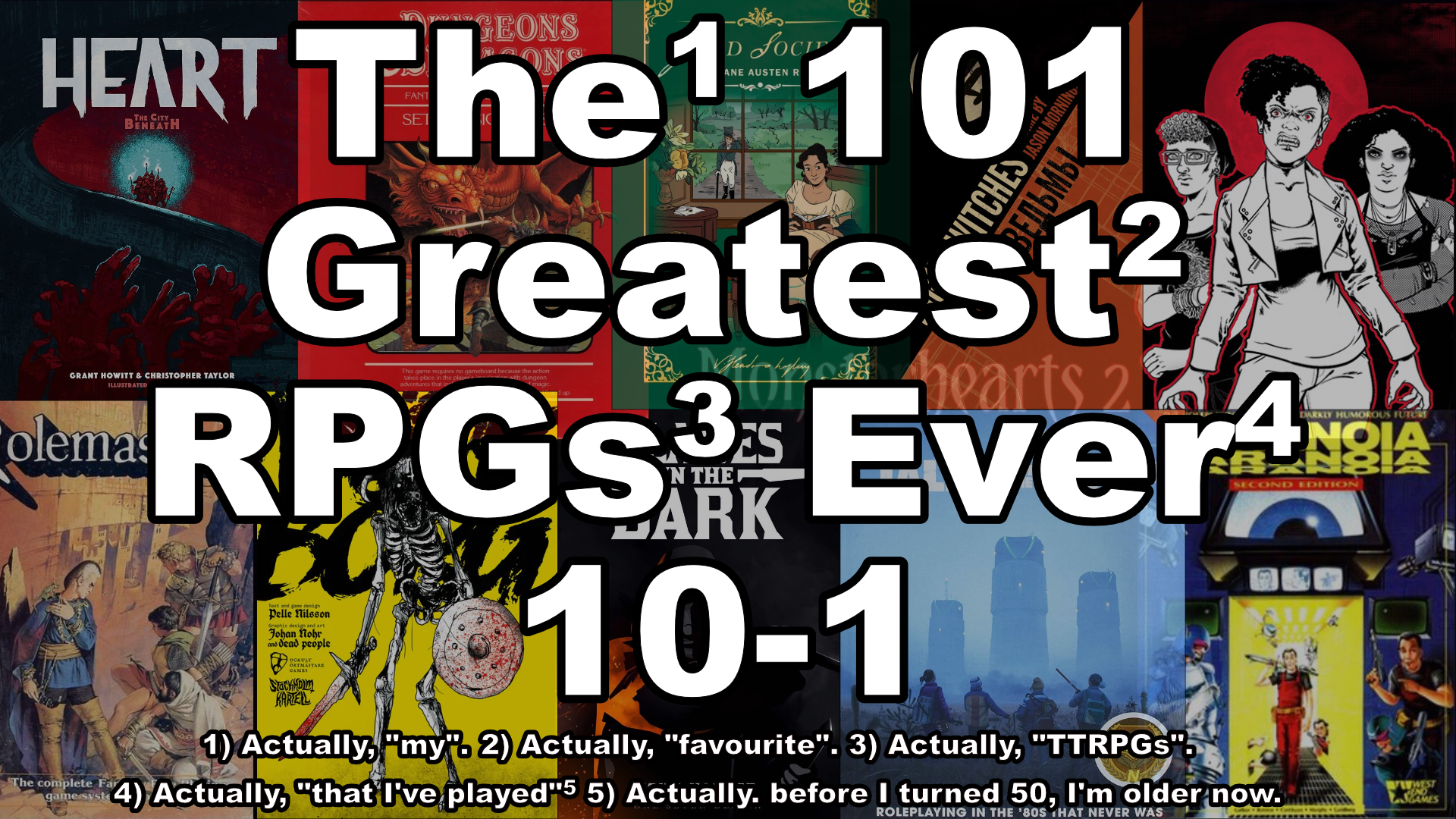

Lawks. We’ve only gone and done it. I set myself a year to write about my 101 favourite TTRPGs. In my tribute to freelancers everywhere, I do almost all the work in the last 10% of the time available. But it got done, and this is where it’s all been leading: the Top 10 Best (not best) TTRPGs that I played before I turned 50, written about before I turned 51. We are deep in formative game territory, plus some total crushes I can’t resist. First up…
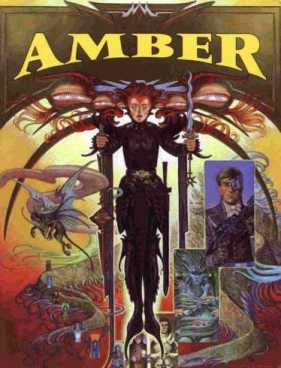
10) Amber Diceless Roleplaying
There’s a version of my gaming history that ends here – the last game I played at University, before going out into the real world, getting an actual job and never thinking about TTRPGs ever again. No, I don’t believe in that world either. My ability to imagine fantasies only goes so far.
I didn’t play many RPGs at university, actually. I played games in the year in the Denver lab, but that was expressly away from the scene. There was a dalliance the boffer LARP society in the first year. There was online MUSH stuff. There was a handful of games with friends back in Stafford in breaks, but there were only two games I played at University. One was Amber.
The year in the lab reawakened my curiosity for the form, and I must have seen an AMBER game advertised somewhere. So I jumped aboard, and then I played a second game, stretching into the liminal summer after graduation. First game had… how many players? 8? Maybe more? The second had so many they had a second GM to try and keep this game of Machievellian dimension-skipping backstabbing sibling fuckwits running. It ran. Downhill, uphill, in all directions, a glorious mess.
Amber is mainly known for the “Diceless” word in the title. Not ruleless – there’s almost a GURPSian amount of character construction numbers. Hell, it’s an RPG where you can get more points if you promise to write poetry about every session, but if you don’t, you’ll be increasingly punished by the universe. Which is unlike being an actual poet, where if you write poetry, you’re punished by the universe.
So not uncomplex, but certainly without dice. It’s brutal in its simplicity. The character with the higher stat beats the character with the lower stat in any direct competition. There’s an auction in character generation, with players bidding against one another to try and be top dog. That’s the only real knowledge you have about each others’capacities – which is more than you have for anyone else in the game. So (say) if they improved, and you face off against them and you will instantly discover you are no longer top dog, as you’re already on the floor.
This works with everyone else in the game too. It’s like gunslingers in the west. The only way you can really find out is if you draw, and you’ll know. You’ll know by whether or not your guts are inside your body or not.
It’s not quite all PvP (though also not NOT PvP) but what Amber does with dancing with its inspiration novels (i’d only read one at the time) is really baroque, and the game is the sort of trad manual that emerges when a designer who wants to make a game without rules but is unfortunately alive in 1990. It’s a real curio, but an influential one – AmberMUSH is a nexus point for a surprising amount of interesting early 2000s design.
A final thought: I finally read the books a few years ago. It was prompted by a conversation with MacGuffin and Company’s Sasha Sienna about Amber, which led to me finding and buying them a copy in a swapsie with their excellent Odd Jobs. But before handing it over, I found myself flicking, and the Proustian (see later) rush made me realise I should actually read it – and if I read this, I should finally just read all the novels, as this manual clearly spoils every single thing in them.
Anyway – I read it all, and the novel and was struck: oh, man, with all the small-p political stories I’ve done about warring families (found or otherwise)? Amber is all over them, up with any of the influences I’m consciously aware of. I guess the ultimate in Diceless Roleplaying is writing fiction.
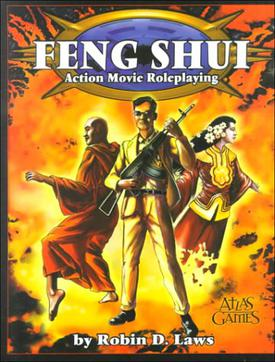
This was the other game I played at university – specifically hacking it to a Xena-inspired fantasy gun-opera romp. Once I’d played Feng Shui, there was no way I was going to go back to anything more trad. Why roll to hit, when you can roll across a bar with your dual 9s?
I was introduced to Feng Shui in my year in America. We all got together and spent the afternoon watching The Killer – my first exposure to Hong Kong cinema – and dived straight into this. Talk about a time. It instantly clicked. I’ve rarely been more disappointed with a player than the guy in the group, who was playing the big lug, and chose to step aside from some falling masonry rather than catch it and throw it at the baddies or punch it into pieces. Dude! Feng Shui understands the assignment. Try and keep up.
Jim wrote about me running Feng Shui unlocking his perspective of what TTRPGs could be – specifically my paraphrased (incorrect) ruling that the less likely an action, the more likely it’s to happen. Shooting someone, hard. Shooting someone while sliding down a bar, shattering glasses? Significantly easier. That’s not really true as written – it’s repetitive actions which are harder, and difficulty is mostly unconnected with the task. If it ends up with a mook dead, it’s equally as hard. It’s a game where each dice-roll is a prompt for the most spectacular action you can narrate.
I came back to it for The Group, and it didn’t quite land. Twenty years on, it’s slightly too trad – all the counting actions and so on. There wasn’t quite the embracing of the iconic roles and scale. I probably should have made everyone watch the Killer before we kicked off.
One moment I remember afterwads was the Critic opining that we don’t really like combat in games. And I just tilted my head and thought “Oh, we are very different people.” That said, my day job is working out new ways for people to punch each other in the face, so that’s probably not a surprise.
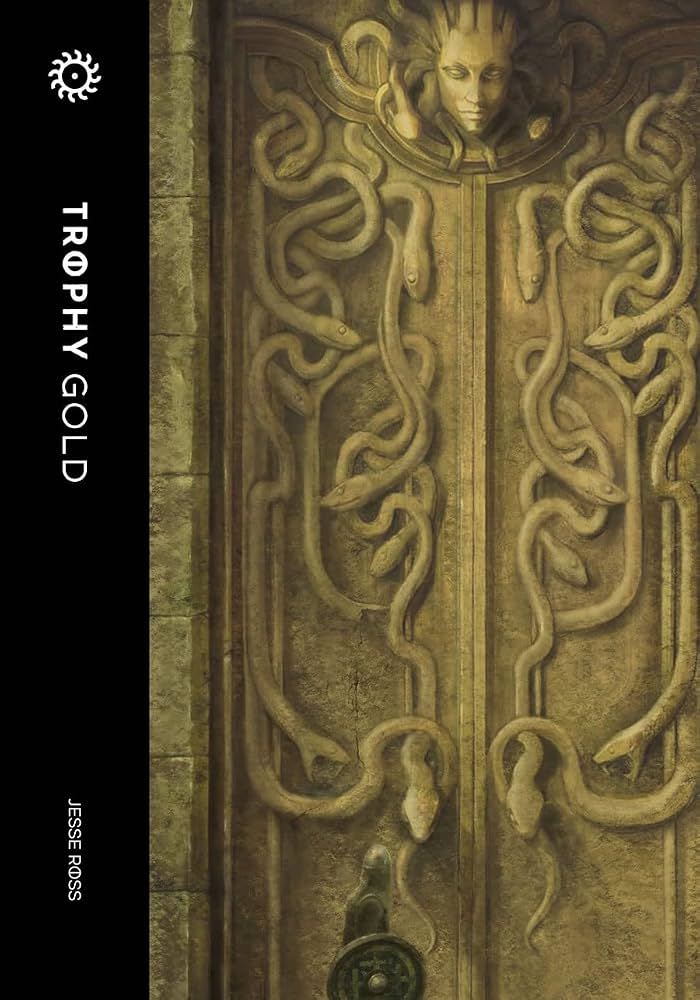
8) Trophy Gold
I actually wrote a full review of this Grimy Fantasy Get Gold Or Die ’em Up, if you want to know why I think it’s so neat and groovy. Writing this made me think “Is this the Fantasy TTRPG I’d run to demonstrate what’s so fun about fantasy TTRPGs in the archetypal sense?” and the answer is “Yes” but “Also, no, not to anyone who needs a demonstration.”
As I write in the review, it’s a game which rewards skill on two separate axis. One is the OSR-y player-skill response to being in a real environment and trying to work out the best ways to mitigate risk. The other being the storygame, player-creativity in running and building with fiction, making big, bold characterful choices. With Trophy Gold really can do both, and in play, shows why both are great. However, to really make it work, you need folks who are grounded in both traditions, and can codeswitch as the game demands.
If you’re in that place – and it’s a place worth getting to – Trophy Gold is it.
Oh – and let me quickly edit this in: this is also the only game I’ve ever played with my four year old. I found she had borrowed one of the deluxe edition’s metal coins for her own. I said I needed it for a game, and she had to see why, so I showed her the box, with its transparent dice and coins. Clearly. she demanded to play.
So we played a game where is going into a forest (eventually with her friend Mr Centaur) trying to find gold. And whenever she looks for them, she rolls all the money dice, and gets that amount of money. Any time there’s a problem, she rolls the dark dice and any 4+ makes it happen. And she uses the light dice as bribes to get dragons to obey her, a mechanic she made up entirely by herself.
Anyway, to cut a long story short, my attempt to recover a Trophy coin has led to her having all my Trophy coins and dice, and I’m never getting them back.
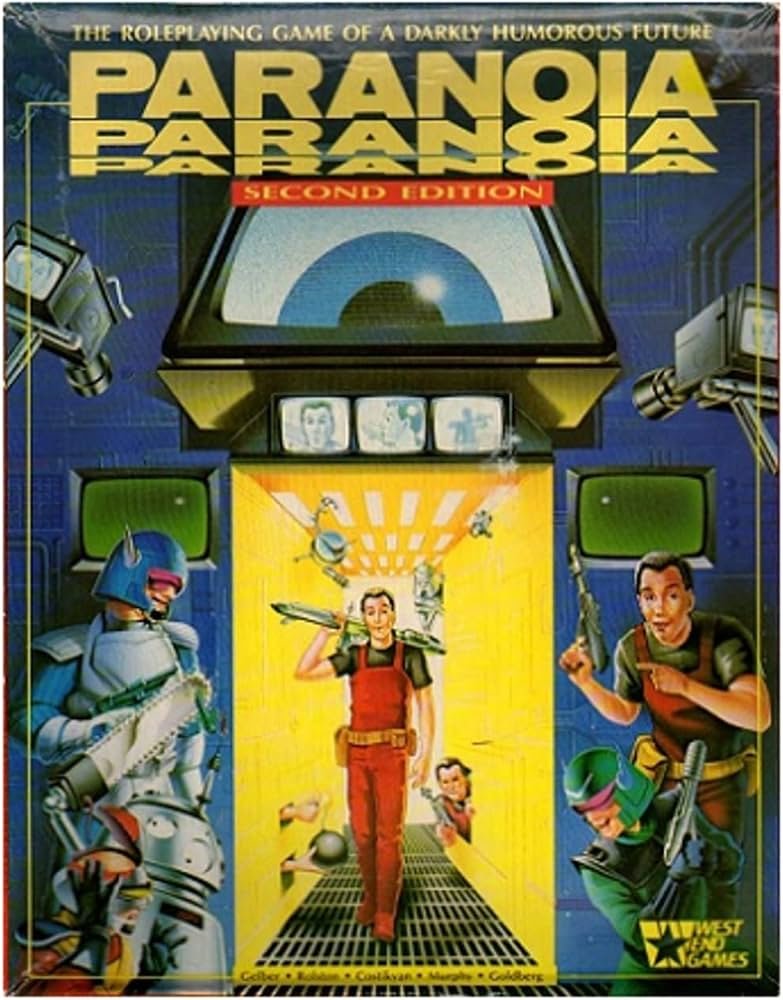
I once argued games are either fanfic (complimentary) or high art. A game is either their inspirations or they are themselves. Paranoia is the first game I ever saw which was high art, which is perhaps illustrative of my own definition – and showing how low high art can be.
With bunker-based Friend-Computer cloned-character ‘em up Paranoia, it’s important to think of context – what Gareth Hanrahahan calls the Cambrian age of TTRPGs, with this first burst of rapid life appearing. There was a lot of new games. However, even in this context, there was nothing like it. Is it a satire of the murder-hobo PCs? Yes. Is it a satire of dystopian fiction? Also, yes. Is it… well, with Paranoia, you can list the ways to look at it. Eventually you get to the point where the only question you can really ask is “Is it Paranoia?”
Yes. It is never anything less than Paranoia.
The ad copy on the back of my edition is just a masterclass.
“Imagine a world designed by Kafka, Stalin, Orwell, Huxley, Sartre and the Marx Brothers.”
As a young teen, I knew about half the names, and knew that I should know the other half, but also knew just enough to get the joke. You don’t get something like this written on the back of your common or garden orc-genocide-’em-up.
The introductory scenario is about stadium-sized cockroaches who want to read Proust, which is the context which I was introduced to Proust, and still how I think of him now. He’s the guy who the cockroaches want to read. There’s a thought I have about gatekeeping, which is born of seeing works just leech out anything which asks any knowledge of the (sigh) consumer for fear they won’t get it – at a time when knowledge is far more easily accessible. Why not assume a curiosity and intelligence? Sometimes what some folks take as gatekeeping is just gateshowing. There’s a door here. Whether you go through it is up to you. I’ve always loved work like that – from Vonnegut, to Manic Street Preachers, to Watchmen, to Paranoia.
Paranoia was a game which just showed me doors. Trapdoors, mainly.
So, Paranoia is smart but also spectacularly idiotic. There’s a thing in a pre-gen scenario (Yellow Clearance Black Box Blues, maybe?) where you deliver the briefing to the confused trouble-shooters by sticking a styrofoam cup in your mouth, so it distorts your speech. Are the characters going to mention it (and risk being executed) or go into the mission with no clue what you’re meant to do? Or are they going to just watch you get waves of drool falling down your face? Spoilers: the latter. I do it any time I’ve ran Paranoia, and it always works – at least illustrating in this (yes) satire of GM power, I am also the joke.
Paranoia is also one of my white whales. While other games it’s “can I actually get the Great Pendragon Campaign to table?” with Paranoia, it’s something else. Its “Can I actually run a great game of Paranoia?”
Because that’s the other weird truth in Paranoia. It’s a great game I’ve never ran a great game of.
There’s been fun, but never quite there, living up to the platonic-perfect paranoia that the game’s orwell-to-marx-brothers blurb sold me. That may imply something to you, and you may not be mistaken – but it also doesn’t stop it being one of my favourite games. The one you play in your head counts.
(To state the obvious: a huge influence on DIE RPG.)
6) Those Games I Make Up And Run When People In A Pub Or Somewhere Like That Asks Me What a TTRPG is (Though They Usually Just Say D&D).
It’s somewhere in the back half of the 2010s. I’m over in Ireland at the excellent Big Bang comic shop for a signing, probably. I’m in the pub afterwards, getting on for 11pm and my Taxi turning up. I have to fly back that night.
I’m winding down and saying goodbye when artist Steven Mooney leans over and asks me a question.
(I think it was Mooney, but pub, 11pm, etc)
“Hey, Kieron. You know about this Dungeon & Dragons thing, yeah?”
And I say yes.
“Could you explain it?”
I glance at the time and figure I can.
I ask anyone around the table if they want to play. If so, reach in their pockets and grab whatever spare coins you have. Stick them on the table. I tell them we’re going to tell a story together – I’ll describe the situation, and then you describe what you’re going to do.
Any time you want to take control of the fiction entirely and make a big action? Push a coin over to me.
Let’s go!
So I set up the most basic scene – they’re all in a pub, and a dragon has arrived outside. What do you do?
There’s some chat and someone spends a token to do something like to barricade them all safely inside. They’re wondering what to do next. There’s a moment of silence.
At which point, Dearbhla Kelly pushes a coin across a table.
(I think it was Dearbhla, but pub, 11pm, etc)
“I jump out a window, and decapitate the dragon with a single slice of my sword.”
The rest of the table glances at her, and then glances at me.
“Sound great. Describe it.”
Table goes beserk. Road to Damascas moment. Everyone at the table gets it, and excitement peaks, and – with perfect timing – my taxi arrives and I have to go. with them wanting more. I left with them getting it – shared fantasy which whatever rules you’ve chosen to play kick occasionally. What was a black box was now as simple as this simple idea is. I hear from several of them afterwards that they started to play.
Now, I’m someone who has hot takes on the “what is an RPG? section in manuals, but I’ll spare you – but in reality, the best way to explain an RPG is to just do it, and I recommend it highly.

The game in the Top 10 I’ve played least of – two short campaigns, neither of which I ran. That makes it the highest game in the whole list which I haven’t facilitated. I just love this. Any time I think of it and the world seems brighter, as it’s got Pasión de las Pasiones in it.
It’s the Telenovella PBTA and it consists of nothing but solidified banger with a surface coating of bop. There’s an article series I keep on chewing over, which is basically “What system should you play this classic old adventure or campaign in?” Which seems like it has legs, but I always swiftly realise the best answer is just “Pasión de las Pasiones”. Enemy Within? Masks of Nyarlathotep? The Great Pendragon Campaign? Better with Pasiones.
If I picked a move, it’ll be implying it’s the best, or most characteristic, and that would be deceptive. Even the throwaway playest moves are golden (pushing people into the hotel swimming pool for bonuses! They can get one if they drag you in!). The “reveal a truth which is entirely contradictory to everything we’ve known”! Getting bonuses depending on whether you’re doing your playbook’s thing, which led to me barging into every scene wearing an increasingly spectacular dresses! Entirely customised emotional states for each playbook to trigger! It’s endless. Except it’s not endless – it’s very precisely calibrated to end exactly when you need it, and let the drama take over.
In the last couple of years, among the chattering classes, there has been some talk about how PBTA storygame stuff is a bit played out, and the real heat is coming from OSR adjacent stuff. Which I bristled a bit at, while also seeing that it’s not wrong. Pasión de las Pasiones may be the last PBTA game which I felt every move was a smart move, transcendent, fascinating, hilarious and utterly essential for everyone. And this Kickstarted in 2017.
Which isn’t to say there’s not great stuff in the space – but it’s either stuff which is moving further away from what you may consider core-PBTA (the Carved By Brindlewood stuff, for example) or delving deeper into the mines of Monsterhearts Moria, and not caring if folks think They Delve Too Deep. When I read Praise the Hawkmoth King or Girl Frame I think they’re brilliant, but also I don’t know anyone I’ll play them with, possibly including myself.
Conversely, Pasión de las Pasiones makes me want to run into the street and grab passing strangers. Just a burst of perfect melodrama. If this list doesn’t get finished today, it’s because I’ve done that, sorry.
4) Blades In The Dark
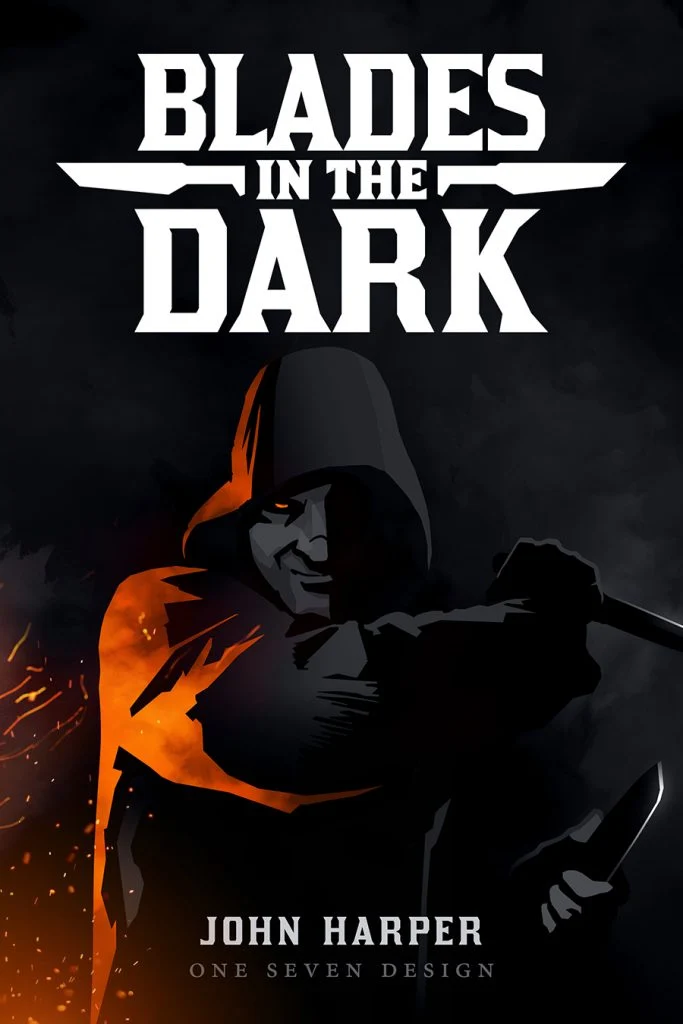
Jon Harper’s masterwork (so far). I talked about the joy of what it does in its worldbuilding over on the Rascal Reading Group Podcast recently, which I direct you to for your Blades kicks. You know the “don’t tell us about your D&D campaign” cliché? This is the absolute opposite that. This is a game that is so feral in story and joy that the day after we played this, a bartender player was cornered at work by his colleagues and asked to fill them in on what down.
With Blades, you can flashback to insert an action you did in the fiction. I’m going to try that, and flashback to me having written this essay last April. Will that work?
No. It appears not.
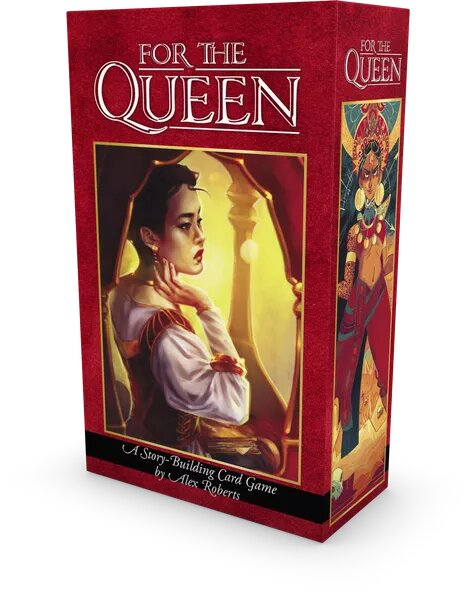
Why is this the RPG you’ve played more than any other game on this list?
How does this so elegantly teach itself?
How is this deck of questions like a dungeon, with every card a junction?
How does this game illustrate the power of a precise question?
How does opening this deck in cards create a world within an hour?
When did the game’s slow steady turning of the question cards turn into the ticking clock of a Hitchcockian bomb?
Which question did the awful truth of your relationship with the Queen become apparent?
How wide do you smile when you remember the crechendo in the room as Mike Molcher answered his final question in Oxford that year?
Will you defend For The Queen?
I would die for her.
There’s a line in Nick Kent’s The Dark Stuff, where Marianne Faithfull is talking about the Stones. I can’t find my copy, so I’ll paraphrase it to: people looked at us, and said we were corrupted. We weren’t corrupted. We were ripe and ready to fall.
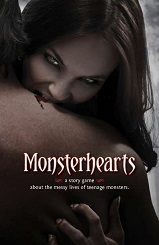
In 2013, with all I’d done and been, I was ripe and ready to fall for for a TTRPG Rolling Stones, and Monsterhearts was it. Or a kind of Stones meets the Velvet Underground’s minimalism, and a post-post-punk’s austerity and understanding of Exactly What It Was Doing.
I wrote about it before. Let me cut and paste the relevant bit…
Why was I attracted, when I spent the 90s dodging playing World of Darkness? Yes, I’m a (blood)sucker for a more explicit queer theme, but that certainly wouldn’t be enough for me now.
But even over a decade on, I read this…
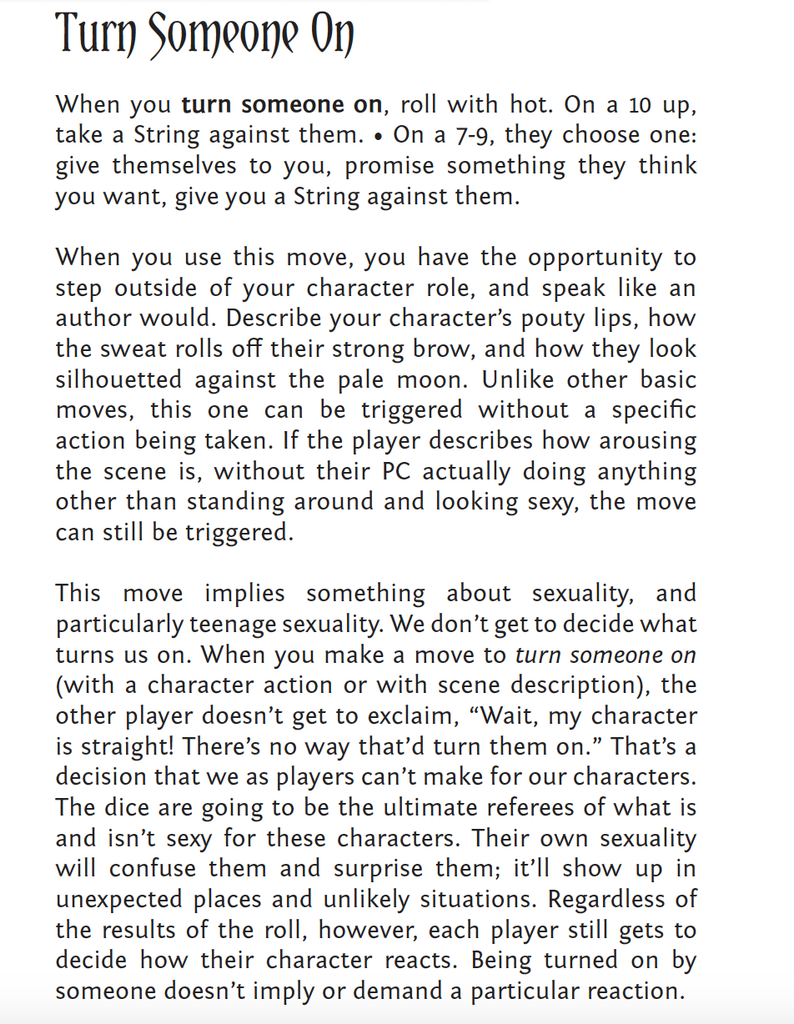
…and I’m as all in as I ever was.
This absolutely understands something about its genre, and has created a mechanic to ensure it happens. This is a story about people’s messy, confused sexual awakening, and you can’t run from it. The game won’t let you.
Instantly, I understood understanding the intent it was done with, and what effect it would have at table. And It did. My first game of Monsterhearts written about by others, and I re-read and still remember how fucking on fire that felt (and not even always in a good way). We were inexperienced teenagers, metaphorically, if not literally. I’ve played it again since – usually one offs, often in the advanced extended version of “Those Games I Make Up And Run When People In A Pub Or Somewhere Like That Asks Me What a TTRPG is (Though They Usually Day D&D).” As in, I know what RPGs are. What else are they? They can be this.
I find it interesting that while this was my way in, the list above shows that I rarely play games that go harder than Monsterhearts. That says something about me, certainly, but it also makes me think how well Monsterhearts judges itself – the economy of its design and writing is one thing – but also a precision in placing itself aesthetically. It goes as hard as it needs, and not an inch further.
It’s a game that has changed my life, and I wouldn’t be writing this sentence without it.
1) DIE RPG
Well, if we’re talking about games that changed my life…
There’s a lot I could say here, and – as Grant would put it – you have a blog, Kieron. I’ll keep it short, as I’m aware that every word I write means it slightly less likely it’ll be posted today. Jim has to have at least scan this, to make sure I haven’t entered my PIN number by muscle-memory instinct.
Why is this my favourite TTRPG? There is the easy joke answer is that all other TTRPGs have cost me money, while this made me money, so clearly has to be my favourite.
The truth is more sentimental and personal. I’ve done a lot of work across my career which is trying to demystify and act as an encouragement towards people’s own creativity. Phonogram is about “you can think of music in this way.” WicDiv is about encouraging you to do it. Young Avengers opened with Being A Superhero Is Amazing, Everyone Should Try it, and then proceeded to spend fifteen issues defining Superhero as an active, human, caring being on this planet, aware of their own agency and using it. When a games journo, I encouraged new writers and pushed their own things. I hired them. I firmly believed (and believe) the world is better if everyone wrote a zine. Expression transforms you and reminds you of your power, and I’m in awe of it. You matter. You’re amazing. To be human is beautiful and I’m interested in you.
While all of the examples are precious, DIE RPG is the one which has had the most direct effect towards those goals. As I wrote in the designer notes, “if someone had told me the joy in seeing people take a structure you made and watching them run with it and making it their own, I’d have done this years ago.” A critic friend of mine notes that DIE RPG is, to some degree, a How To Do Stories The Kieron Gillen Way. She’s right. But to see people do that, and then also build on it and make it their own? It’s humbling in every single way.
It’s also a game that includes my whole journey towards it. It’s all the games I played beforehand. It’s the filter I consider games I’ve played afterwards. It’s something I understood how I wanted it to work from the moment of conception and simultaneously something I understand better now than I ever did then. It’s the longest campaign I ran in my life, and the precious time with the friends around that table and zooms in the covid lockdowns was holy time. It’s my life. I’m aware that for an RPG called “DIE” to be so connected with life is perhaps an irony. One should remember that death presupposes a life that’s ended – nonexistence is by definition nothing. Death is about what is gone. Death is only ever about life.
I was lucky enough to share my time with so many folks over the year, playing all the above games and I’m grateful for every second. Even the ones with Rolemaster.
Thanks for reading.
Next: the list is over, you fool of a Took. Though I’m sure I’ll do a All The Games In One Post megalist.

Kieron Gillen lives in Bath, for a certain value of the word “lives”.
For some reason I cannot fathom, I own four copies of Feng Shui. I thought I only had one, the original copy I bought, prompted by the very positive review in arcane #1, but took ages to actually get because it wasn’t in fact in print, or something.
Anyway, I played it exactly once, had one of the best rpg sessions of my life, and then never played it again. But somehow acquired three more copies.